Showing posts with label Monsters. Show all posts

Sunday, October 31, 2021

This Year, Don't Forget About Lamashtu!

It's Halloween again. Here in North America, the date is marked with costumes and candy. The yards of our city are littered with the symbolism of fear. On my walk earlier today, I spotted Styrofoam tombstones, inflatable undead, plastic dismembered arms, spray-on spider webs (a spider's deathtrap), carrion crows and rats, dancing skeletons, and pumpkins carved with the faces of evil so as to ward it off.

But nowhere did I see an image of Lamaštu, that most feared of Babylonian evils.

Image Source: https://en.wikipedia.org/wiki/Lamashtu


Lamaštu was one of the most dreadful beings of the Ancient Near East. She was sometimes called a demon, but like all Babylonian demons she defies easy classification in modern terms. She was the daughter of Anu, the father of the gods, but she was an outcast and a hybrid. She was often ranked among the Utukku (evil spirits) - not because she was born before the ordering of the universe like they were, but because her evil and rebellious plan to eat mankind for dinner put the gods in mind of evil spirits. For this, she was demoted from the rank of goddess to the rank of utukku, given a canine's head by Enlil, and thrown out of heaven.

There is no catalogue of her activities on earth, though she is quite famous for sucking the breath of newborns from their young bodies, thereby causing crib death. She could be turned away by showing her her own image, or that of the demon Pazuzu.

Those who could afford such things could hire an exorcist to ward her off with an incantation. Several such have been immortalized on clay tablets. If you haven't place a likeness of Lamaštu on your front yard this year, you might consider lighting a few candles, offering up a pure white lamb, and reciting one of these incantations for protection. 
These first two incantations against Lamaštu are quite old and come from early Aššur:

“She is singular, she is uncanny,
She is a child born late in life, she is a phantasm,
She is haunt, she is malicious,
Offspring of a god, daughter of Anu.
For her malevolent will, for her base counsel,
Anu her father dashed her down from heaven to earth,
for her malevolent will, her inflamatory council.
Her hair is askew, her loincloth is torn away.
She makes her was straight to the person without a god.
She can benumb the sinews of a lion, she can still the sinews of a youngster or infant.”
“She is furious, she is terrifying,
She is uncanny, she has an awful glamour,
She is a she-wolf, the daughter of Anu,
Her dwelling in is the grass,
Her lair is in the weeds.
She holds back the full-grown youth in rapid progress,
She yanks out by the breech the premature child,
She brains little babies,
She makes the witnesses swallow the birth fluids.
This spell is not mine; it is a spell of Ninkilim, master of spells.
Ninkarak cast it so I took it up.*"
[Source: Before the Muses: An Anthology of Akkadian Literature
Benjamin R. Foster, Third Edition 2005 CDL Press. 1044 pp.]

*Here I think this refers to Ningirin, goddess of incantations, as the composer of the spell, rather than Ninkilim, goddess of mice and rodents. Ninkarak was a name for the healing goddess, Gula. These lines mean that Ningirin composed the incantation, Ninkarak cast it, and the scribe recorded it.

This third incantation is a little younger and comes from Akkad.
“Anu begot her, Ea reared her,
Enlil doomed her the face of a lioness.
She is furious. She is long of the hand, longer still of the nail.
Her forearms are smeared with blood.
She came right in the front door, slithering over the door frame
She has caught sight of the baby!
Seven seizures has she done him in his belly!
Pluck out your nails! Let loose your arms!
Before he gets to you, valiant Ea, sage of the magical art,
The door frame is big enough for you; the doors are open.
Come, then, begone into the open country!
I will surely fill your mouth with sand, your face with dust,
Your mouth with finely ground mustard seeds!
I exorcise you by Ea's curse: you must be gone!”
[Source: Before the Muses: An Anthology of Akkadian Literature
Benjamin R. Foster, Third Edition 2005 CDL Press. 1044 pp.]


Image Source: https://en.wikipedia.org/wiki/Lamashtu


Another juicy spell can be found in Karen Nemet-Nejat's wonderful introductory book: Daily Life in Ancient Mesopotamia.
“She comes up from the swamp,
is fierce, terrible, forceful, destructive, powerful:
(and still) she is a goddess, awe inspiring.
Her feet are those of an eagle, her hands mean decay.
Her fingernails are long, her armpits unshaven...
The daughter of Anu counts the pregnant women daily,
follows on the heels of those about to give birth.
She counts their months, marks their days on the wall.
Against those just giving birth she casts a spell:
“Bring me your sons, let me nurse them. 
In the mouth of your daughters I want to place my breast!”
She loved to drink bubbling human blood,
(eats) flesh not to be eaten, (picks) bones not to
be picked. (From Lamaštu series, Tablet 1)"
[Source: Daily Life in Ancient Mesopotamia
Karen Rhea Nemet-Nejat, 1998 Hendrickson Publishers. 346pp.]
OK, let's face it: it's probably too late for you to protect yourself for Halloween this year. But if you're still around next Halloween, why not throw up a likeness of Lamaštu on the front lawn? You'll be well protected, and who knows? Maybe even, like the local woman who last year strung headless Barbie dolls like garlands from tree to tree over her front walkway, become the talk of the town!

Saturday, June 13, 2020

Campaign Report: John of Patmos' Mythic Babylon Campaign Part 2: "Apocalypse"

This week we continue with the second and final part of John of Patmos' Mythic Babylon campaign report. See the previous post for part 1 and a link to the music of Aphrodite's Child which you should be listening to as you read this.

7. THE LOWER SEA (17)

While the player-characters were busy in Babylon, something else was going on a few hundred double-miles to the south – a great ripple in the Lower Sea. Silanum's answer to the cries of the people was amplified by Ea and reached even to the Kulullu and Kuliltu people 
(18) who live beneath the waves of the Lower Sea.

Lyrics

I saw the souls
I saw the martyrs
I heard them crying
I heard them shouting
They were dressed in white
they've been told to wait

The sun was black
the moon was red
the stars were falling
the earth has trembling
And then a crowd impossible to number
Dressed in white
carrying palms
shouted amid
the hotless sun
the lightless moon
the windless earth
the colourless sky ...

They'll no more suffer from hunger
they'll no more suffer from thirst
They'll no more suffer from hunger
they'll no more suffer from thirst
They'll no more suffer from hunger
they'll no more suffer from thirst

They heard and heeded the call, but were greatly disturbed by a disturbance from the depths. Something very old was approaching from the open ocean. 

They cried out it's name in warning to the people of Babylon: “An-Dammu! An-Dammu!” (19) The ecstatic prophets of Babylon heard the name and took up the cry in the streets of the city, but few could heed or understand them. After crying their warning, the Mer-people fled into the the shelter of the Abzu (20) where Ea offered them protection.


NOTES

17. In the opera, the band called this track Aegian Sea in order to make the work more accessible to their audience.

18. Kulullu and Kuliltu are the Akkadian names for Mer-men and Mer-women.

19. The name An-Dammu means 'Spouse of Heaven' and can be arrived at by rolling the numbers 6-1-6 on the Babylonian name generator, or by rolling 6-6-6 if one accepts that An-Dammu's city of origin is heaven itself. John of Patmos invented her for the campaign, and saw her as a beast birthed by Temtu (the Sumerian primordial sea, later called Tiamat), who birthed many monsters, demons, and hybrids. An-Dammu is betrothed to Anu, the god of Heaven. In the Middle Babylonian Creation Myth, Marduk would defeat Tiamat to become king of the gods. But in this campaign its her offspring that's defeated.

20. The Abzu is the subterranean water, the domain of Ea.


8. SEVEN BOWLS

We return again to the action in Babylon. After the half-hour of silence that followed the opening of the seventh seal (see Part 1), the statues of the seven great gods animated. They walked from their inner sanctuaries to the gates of their temples, seeming to grow in size as they did so. Each carried a bowl in their left hand and a trumpet in their right. They then raised their trumpets to their mouths and, as the trumpets rang out across the land, overturned their bowls - and the punishment of the gods was poured out.

The god Adad overturned the first bowl, and a mixture of hail, fire, and blood fell to the earth, killing a third of all trees and grasses.

The god An overturned the second bowl and a mountain fell from the sky into the ocean, killing a third of all marine life.

The goddess Ištar overturned the third bowl, and a star fell from heaven and poisoned a third of all rivers and springs.

The god Šamaš overturned the fourth bowl, and a third of the sun, moon, and stars disappeared, creating total darkness for a third of the day and the night.

The god Sin overturned the fifth bowl, and another star fell from the sky and created a great rift in the ground, open to the underworld. Out of this poured a cloud of smoke, and from the smoke came locusts who were "given power like that of scorpions of the earth", and who were commanded not to harm anyone given the "seal of God" on their foreheads. These "locusts" had a human appearance (faces and hair) but with lion's teeth, and wearing breastplates of meteoric iron (21). The sound of their wings resembled "the thundering of many horses and chariots rushing into battle." They flocked to the shore of the Lower Sea, there to await An-Dammu, who was soon to emerge from the sea.

The god Ea overturned the sixth bowl, and the four winds blew the remaining stars out of the sky. When they fall to earth, they were seen to be two hundred million charioteers with flaming wheels and smoke pouring out behind them.

The god Enlil overturned the seventh bowl, and a vision of the Tablet of Destinies was revealed to all – Enlil was shocked to see that the tablet was inside the temple of Marduk, rather than inside his own temple, and that the priestess Silanum was writing furiously within. He unleashed thunder, lighting, and hail to the earth, in order to sweep aside all those remaining in the city, including Silanum – but those marked with the triangle on their foreheads were protected by Ea. So Enlil called forth the beast!

Lyrics:

The first bowl on the earth
the second bowl on the sea
the third bowl on the rivers
the fourth bowl on the sun
the fifth bowl on the Beast
the sixth bowl on the stars
the seventh bowl on the air

And the earth turned grey
the sea turned black
the rivers turned red
the sun turned cold
the Beast turned pale
the stars turned fast
the air turned to poison


NOTES:

21. These locust men were invented by John for the campaign – they aren't mentioned in Babylonian myth, though they definitely fit the idiom For stats, he used modified Pazuzu (a demon) from the book.


9. THE WAKENING OF THE BEAST


This instrumental track in the album turns our attention back to the Lower Sea for a moment, where at last the beast, An-Dammu, is emerging – a monstrous seven headed serpent with poisonous blood!


10. LAMENT


Back on the ziggurat of Marduk, the nameless Gala Priestess character sang out a lamentation for those who were lost, by which to give hope to those who remained.

Lyrics

Alas alas
for the human race
alas
for the kings,
the kings of separation


11. THE MARCHING BEAST


Enlil had seemingly been foiled, because not everyone was dead! He had once again been tricked by Ea and now saw the writing on the Tablet of Destinies. He instructed his step mother, An-Dammu, to march northward at the head of her locust army to put an end to people forever.

But though things looked grim for the followers of Marduk, all was not lost. The stars that had descended to earth as flaming chariots when Ea overturned the fifth bowl were now revealed to be pulled by Apsasus and Aladlammus (22), They are driven by Lahmu (23) and their regiments commanded by the Apkallu (24). Marduk then stepped from his temple and called upon his followers to jump on chariots and join the fight! And so the PCs did!


NOTES

22. Apsasu and Aladlammu are the Old Babylonian period names for the iconic winged, human-headed bulls that guard the homes of the gods. They are female and male respectively – it's not known if there was more than one of each, but in Mythic Babylon we generally assume so.

23. Lahmu are 'hairy-hero-men' hybrids, created by and servants to Ea.

24. The Apkallu are the Seven Sages, originally sent to earth to instruct humans in the arts of the ME (the trappings of civilization.) By the time of Mythic Babylon, they no longer seem to walk the earth, but it is assumed they will return at times of need. 

Source: Oriental Institute of the University of Chicago


12. THE BATTLE OF THE LOCUSTS

13. DO IT

14. TRIBULATION


These three instrumental tracks describe how the army of Marduk and the army of An-Dammu met for a climactic battle on the fields outside Enlil's home city of Nibbur. The player characters, drawn by Ea's fantastical chariots, helped fight the onslaught of locust men.


15. THE BEAST


Fighting the locusts seemed futile, and the player-characters soon realized that the path to victory lay in helping Marduk kill An-Dammu, so they directed their chariots to help find the beast.

Lyrics:

Who can find the Beast?
She's big,
she's bad,
she's wicked,
she's sad
Who can fight the Beast?

She come's,
she goes,
who ever knows ...
Who can fight the Beast?

She's big,
she's bad,
she's wicked,
she's sad
Who can find the Beast?

She come's,
she goes,
who ever knows ...
Who can find the Beast?


16. OFIS


At last, the shape of the giant seven-headed serpent was spotted through the smoke, and Marduk called out a challenge:


Lyrics

Come out, cursed serpent,
because if you don't out yourself,
I will out you! (25)


The two gods squared off, and Marduk drove An-Dammu into the marshes while the players fought off her Umu (26) demon lieutenants. Driven back, An-Dammu disappeared into the bog. The locust army was now defeated, but there is also much injury on the side of humanity, so a temporary withdrawal was called.

NOTES

25. Apparently these words were later placed into the mouth of Alexander the Great in another campaign run by one of the players from this one called Alexander the Great and the Cursed Serpent.

26. Umu demons are 'Roaring Weather Beasts,' creatures of Mythic Babylon that resemble Runequest's whirlvishes.


17. SEVEN TRUMPETS

The great gods rang out seven trumpets again, this time to mark the victory of Marduk and hail him as the new king. Enlil accepted his defeat and agreed to step down as king of the gods, though he would keep his sky domain. The army of Marduk re-grouped at the foot of the Duranki (Navel of Heaven and Earth), the great ziggurat of Enlil in Nibbur.

Lyrics

Ladies and gentlemen
Seven trumpets
the sound of thunder!
Seven trumpets
the threatening anger!
Seven trumpets
the trembling voice!

Seven trumpets
You got no choice!
Seven trumpets
the seven angels!
the seven trumpets
the music changes!

18. ALTAMONT

Marduk now sat on the throne of Enlil in Nibbur and his high priestess, Silanum appeared once gain to recite an exaltation to the assembled followers of Marduk:

Lyrics:

This is the sight we had one day
on the High Mountain
We saw a lamb with seven eyes
We saw a beast with seven horns

and a book with seven seals
Seven angels with seven trumpets
and seven bowls filed with anger

Those are the pictures
of what was
of what is
of what has to come

We are the people
the rolling people
the why people
the waiting people
the wanting people
the tambourine people
the alternative people
the angel people

19. THE WEDDING OF THE LAMB

Following her song, Silanum (“The Lamb”) was symbolically married to Marduk (The Shepherd), and the god and his people were formally united.


20. THE CAPTURE OF THE BEAST

One final task was given to the players – to enter the swamp and capture the beast, and bring her back to Nibbur to face the punishment of the gods. They headed to the marsh at the head of a posse of Ea's inhuman servants and followed her to her lair. She was much diminished by this time, but still dangerous (27). Because of her Melammu (28), the players needed to make willpower tests just to approach her.


NOTES

27. For this encounter, John used the statistics for Mušmahhu, the great seven-headed serpent. 

28. Melammu ('Frightening Splendour') is the aura that surrounds gods and certain other beings.


21. INFINITY

After fighting for a time, with both sides suffering significant injuries, The Beast opened a dialogue with the player-characters, attempting to get them to her side. They allowed her to speak while they also caught their breath. She explained that she could not be killed; that she was primordial. She existed before the gods, and would come again after them. Her role on the planet was to herald change and create new orders, not to be enslaved.

Lyrics:

I was
I am
I am to come

The players tested their purity to decide how to react to the beast, and decided to let her go. It was the Gods and Samsu-Ditana who brought all this about, afterall. The beast needed to exist in order to redress the imbalance. So they let her go, and returned to Nibbur to meet their own punishment for defying the gods.


22. HIC AND NUNC

The characters returned to Nibbur to be tried by the gods, and the stated their case before the great council of Marduk. Afterward, Silanum came to their cell to tell them they had been pardoned. She made a final speech, and sang a song of praise to the characters who helped save the world and usher in the new order. 

With this, the campaign came to a close. In his de-briefing afterwards, John of Patmos revealed that the Kassite character's offspring with Silanum would form the next ruling human dynasty of Babylon.

Lyrics:

Here and now!
Here and now!

Fixing the ceiling
I got a feeling
- sing it again!

Here and now!
Here and now!

Show me the season,
give me the reason
sing it again!

Here and now!
Here and now!

Whisper a meaning
nobody's leading
sing it again!
sing it again!

Here and now!
Here and now!

I got a feeling
somebody's missing
sing it again!
sing it again!

Here and now!
Here and now!


23. ALL THE SEATS WERE OCCUPIED

The campaign ended, but the rock opera concludes with two remaining tracks. This one summarizes the campaign, hitting the highlights and commending the GM on not killing a single player-character.


24. BREAK

And finally, a goodbye from the group as they planned to split up for the summer at the end of term. In fact, they were never able to get everyone together for a game again. Some have argued that every campaign can only exist once, and the Apocalypse of John of Patmos can never be re-created. Can't it? Do it!

Lyrics:

Bye bye, my friend, goodbye
With a lie
you forget and break it

You make it
You make it
You make it
You make it

Cry in my empty room
and we try
to forget and break it

Fly
high
and then
you make it

[interlude]

Bye bye, my friend, goodbye
With a lie
you forget and break it

You make it
You make it
You make it
Oh you make it
Oh, ah. ah.


Do it!


Sunday, June 7, 2020

Campaign Report: John of Patmos' Mythic Babylon Campaign Part 1: "Revelation"

For this entry I thought I'd share an early campaign report for the forthcoming Mythic Babylon. This was run in Greece by a GM known on the web as 'John of Patmos.' The campaign was written up by the GM in Greek and I understand has been translated a few times and published in some anthologies of similar campaign reports, but I find it a bit convoluted. So in this case I thought I'd turn to a separate campaign report prepared by the players, which is a lot more concise. The players were a group of musician friends who released their report in the form of a prog rock opera (I know right? Who does that?! (1)) called 666 . It's really good – you can find it on youtube if you search for Aphrodite's Child 666. So what follows is a summary of the campaign based on the rock opera, with a bit of additional material from John of Patmos' version. I hope you enjoy it as much as I did.


HISTORICAL BACKGROUND

The campaign begins in Babylon. Rather than use the default start date presented in Mythic Babylon, John decided to run the game in the year 1595 BC at the very end of the Old Babylonian Period. Samsu-Ditana ( https://en.wikipedia.org/wiki/Samsu-Ditana ) was the King of Babylon at the time, and Babylon a city that had controlled access to the Tigris and Euphrates rivers (both important trade routes) in central Babylonia for nearly 200 years. Their rivals at this time were the Kingdom of the Sealand to the south, ruled by King Gulkišar, the Kingdom of Elam in the east, ruled by Širtuh, King of Susa, and the Hittites to the north under King Mursili, who is historically credited with bringing about the first fall of Babylon.

NOTES


1. Okay, my friend Clash Bowley does this, but he's the only one I know.

CAMPAIGN SUMMARY


The events below are presented to coincide with the named tracks on the 666 album. 


1. THE SYSTEM (THEME)

This is the opening track, and it reveals the theme of the campaign, which is destruction and renewal, The lyrics of which quote the GM, John of Patmos who often said 'This is the system to f*** the system', by which he meant 'We'll use Mythras (the game system) to destroy Babylon (the political system).'

2. BABYLON

To open the campaign, John described the scene of a grand week-long festival to that was called celebrate King Samsu-Ditana's ascension to godhood. It was once a custom for kings to ascend to godhood; it was started by King Naram-Sin of Akkad and continued by the Kings of Ur and later of Isin and Larsa; the first two of these fell cataclysmic destruction, and that latter were absorbed by their neighbours. The practice was dropped by the Kings of the first dynasty of Babylon. This campaign is based on the premise that the last king of the dynasty, Samsu-Ditana, was vain enough to re-invoke the practice and thus bring about the end of Babylon.

The opening scene reveals how, masked by all the pomp and circumstance of the festival, the city and it's institutions are actually crumbling from neglect.
Lyrics:

Fallen fallen fallen
is Babylon the great!
Space is getting bounded,
time is getting late! (2)

Masters fall and wonder,
people rise and wait (3)
Fallen fallen fallen
is Babylon the great!

You don't need a coin (4)
I don't have to shine
We don't know the reason

But I need you madly
and you need me too
and we need each other... (5)
and we need each other...

NOTES: 

2. This is a reference to how Babylon has lost it's shine, its greatness has fallen away. But it's also a clever bit of foreshadowing. 'Space is getting bounded' refers to Babylon's shrinking territory, and time is certainly late – historically Samsu-Ditana was the last king of his dynasty. 

3. 'Masters fall and wonder' is here a reference to the nobility of Babylon falling to the ground in worship of their new 'god' Samsu-Ditana. The people, on the other hand, or more skeptical and fearful.

4. 'You don't need a coin' is quite true – obviously the players found it noteworthy that coinage hadn't been invented yet.

5. A reference to both the vanity and neediness of King Samsu-Ditana and the GM himself, perhaps? But it is a truism that gamers need each other – this is a social hobby, afterall.


3. LOUD LOUD LOUD

As I mentioned, the opening scene was one of pomp and circumstance – a grand festival to inaugurate the king. If you've ever read 'The Curse of Agade' 
( https://www.ancient.eu/article/748/the-curse-of-agade-naram-sins-battle-with-the-gods/ ) you'll know this is likely to be an affront to the gods. And to make matters worse, the great god Enlil doesn't like having his rest disturbed by noisy humans ( https://www.ancient.eu/article/227/the-atrahasis-epic-the-great-flood--the-meaning-of/ ).

So, while all this pageantry was happening in the streets, Enlil was plotting once again to rid the world of Humans. And once again, the crafty god Ea decided to work behind the scenes to prevent this from happening. John imagined Ea thinking 'This is the last time I will help Enlil destroy the humans. I will depose Enlil as king of the gods and place my own son, Marduk, god of the city of Babylon, on the throne. That way I will never have to save humankind again.'

So, when Enlil directed Ea to bring about the destruction, he put his plan into effect: Ea instructed Marduk's priestess, Silanum (her name means 'Spring Lamb'), to unlock the box containing Tablet of Destinies which records the grand plan of the gods for the future of everything. He told Enlil he would unlock the tablet to write the end of human-kind, and on the surface that's what this looked like, but the tablet was really going to be used to re-write out of the position of King of the Gods.

This all happened behind the scenes, of course. The player-characters discovered bits of this plan via prophecy during the campaign which lead up the the apocalypse and the final revelation at the climax.

So, back to the festival, which this track continues to describe. Here John of Patmos described the pageantry in more detail and the players were introduced to the city of Babylon. There were some good role-playing opportunities with various locals, including nobles, priests, craftspeople, and commoners. This scene ends at 6pm - sunset on the first day. The band described it thusly:


Lyrics:

The day the walls of the cities will crumble away (6)
uncovering our naked souls, (7)
we'll all start singing,
shouting, screaming
loud, loud, loud, loud

The day the circus horses will stop turning around, (8)
running fast through the green valleys,
we'll sing and cry and shout
loud, loud, loud, loud

The day the cars will lay in heaps (9)
their wheels turning in vain,
we'll run along the empty highways
shouting, screaming, singing
loud, loud, loud, loud

The day young boys will stop becoming soldiers,
and soldiers will stop playing war games, (10)
we'll sing and cry and shout
loud, loud, loud, loud

The day will come up
that we'll all wake up
hearing and shouting of joy
and shouting together with the freaks (11)
loud, loud, loud, loud

The day the world will turn upside down
we'll run together round and round
screaming, shouting, signing
loud, loud, loud, loud
loud, loud, loud, loud (12)

NOTES

6. Babylon's buildings and walls were made from mud brick and in a bad state of decay from neglect. This was in part because all the festivals the king insisted on holding were keeping the builders from their work. Mud-brick construction is prone to decay, so in some sense the walls were always crumbling, except when kings organized a work crew to re-construct them. But as is implied in verse four, the citizens of the city had been exempted from their normal conscription duties, so there's no-one to repair the walls, and no militia to deal with an emergency. Woe betide the unprepared king who lets his walls collapse just before an apocalypse!

7. Every person had an etemmu, or 'ghost', who can linger in the surface world if their descendants don't treat them well after death. The dead were either buried in cemeteries or under the floor of the family home. Neglect of either could uncover these naked souls and free them to wander the streets. This is exactly what was happening in the city, and the scene ends with a dramatic spirit combat between the characters and some ghosts.

8. This is a reference (with some poetic license) to the absence of horses being sacrificed for the dedication of temples. Without sacrificial horses, temples were not renewed. The houses of the gods were crumbling like everything else. The only new temple was the one dedicated to Samsu-Ditana

9. Typo, here – 'carts' is of course what is meant, their wheels turning in vain in the mud. And note also that the highways (trade routes) were empty - a bad sign when you need to trade your excess grain for metals with which to make weapons or silver currency.

10. Young men were in fact conscripted into war in Mythic Babylon, and also sent to perform other tasks like repairing dilapidated civic structures such a defensive walls and temples. But, to appease troublesome citizens, some cities exempted their citizens from these duties. In this campaign, Babylon was one of them – hence the poor state of the army, temples, canals, and city walls.

11. 'Shouting together with the freaks' is a clear reference to the ecstatic prophets, who were taking to the streets in this episode and later ones to pronounce doom on the city. The characters encountered at least one in this opening session.

12. Some strong fore-shadowing here. This was the day the world started turning upside down. The crowd thundered and Enlil fumed on his mountaintop.


4. THE FOUR HORSEMEN

This track describes several of the early sessions of the campaign into a single song. Things were starting to go bad and the player-characters were sent on various trouble-shooting missions. Here's the summary of events:

During the festival described in the previous session, various gods arrived from other cities – Adad from Karkara, Ištar from Kazallu, Šamaš from Sippar, Sin from Ur, Ea from Eridu, Enlil from Nibbur, and Anu from Uruk, each with their own pageant.

Meanwhile, Marduk's high priestess, Silanum ('the lamb'), was sequestered in the inner sanctum of Marduk's temple upon the E-temenanki ('House of the Foundation of Heaven and Earth') Ziggurat. She started break the seals on the box that contained the Tablet of Destinies, by which to open the fate of the world to change. Each seal required elaborate rituals to unlock, so the process took several hours to complete. Of course, the characters didn't learn this was happening until much later – they were occupied with other things.

From the start of the game, John of Patmos started what he called his 'doomsday clock' to time events. This 'clock' was based on Babylonian numerology, which assigned numbers to the most important gods like this:

10 for Adad, the bringer of storms,
15 for Ištar, the temptress and goddess of battle,
20 for Šamaš, the sun,
30 for Sin, the moon,
40 for Ea, the god of wisdom and maker of humans,
50 for Enlil, king of the gods, and
60 for Anu, father of the gods.

He used this to time the events of play. The first four of these are described in in this song:

THE WHITE HORSE (Day 2 - 4:00 AM)

Ten hours into the festivities, Silanum broke the first seal on the table of destinies – the seal of Adad. An uridimu (a lion with the head of a man) emerged from the temple of Enlil and announced the wrath of Adad. This was accompanied by a storm with driving rain, thunder, and lightning. Prophets cried out about this doom in the city streets, but people thought this was part of the show at this all-night party.

The storm masked the presence of Hittite raiders who were descending on the city from the north. This was an advance party, riding in chariots drawn by white horses and wielding bows. The characters were part of a group sent out to try to prevent the raiders from approaching the city. They managed to fend them off, but the Hittites didn't leave – they made a camp not far from the city.

THE RED HORSE (Day 2 - 9:00 AM)

Fifteen hours into the festivities, Silanum broke the second seal, the seal of Ištar. A kusarikku (bull-man) emerged from the temple of Enlil and announced the arrival of the second doom: The army of the Sealand had arrived, led by King Gulkišar. They came up the Euphrates River on thousands of barges and they begin to assemble their siege equipment, including a monstrous red-painted siege-horse called Zu Gusiaš Temtu ('The Tooth of Temtu' (13)), which was set to work on the weak southern walls of the city. The players characters were joined a sortie sent out to try to disable it and it's inhuman Kurgarra (14) operators. With the destruction of the red horse, the troops surrounding the city settled in for the long haul and blockaded the city, but did not attempt to breach its walls. Again, the citizenry hardly noticed.

THE BLACK HORSE (Day 2 – 2:00PM)

The citizens of Babylon continued to celebrate the ascension of Samsu-Ditana, oblivious to the threats outside the city walls. At the twentieth hour, the Lamb broke the third seal, the seal of Šamaš. Šamaš wass the all-seeing sun, and also the god of justice, fair dealings, and by consequence, of trade. With the breaking of the third seal, a Lahmu (hairy-hero-man) emerged from the temple of Enlil into the unusually scorching afternoon sun and announced the next doom on the city.

An embattled merchant caravan, led by an Elamite trader bearing a scale and leading a trail of black pack horses, managed to break the blockade and enter the city. The merchant spoke of poisoned wheat causing mass death in the surrounding lands, and warned against allowing the forthcoming feast to continue. The characters joined the effort to round up and destroy all the bread they could find before people could eat it – a move heavily opposed by the festival organizers and the king's troops.


THE GREEN HORSE (Day 2 – Midnight)

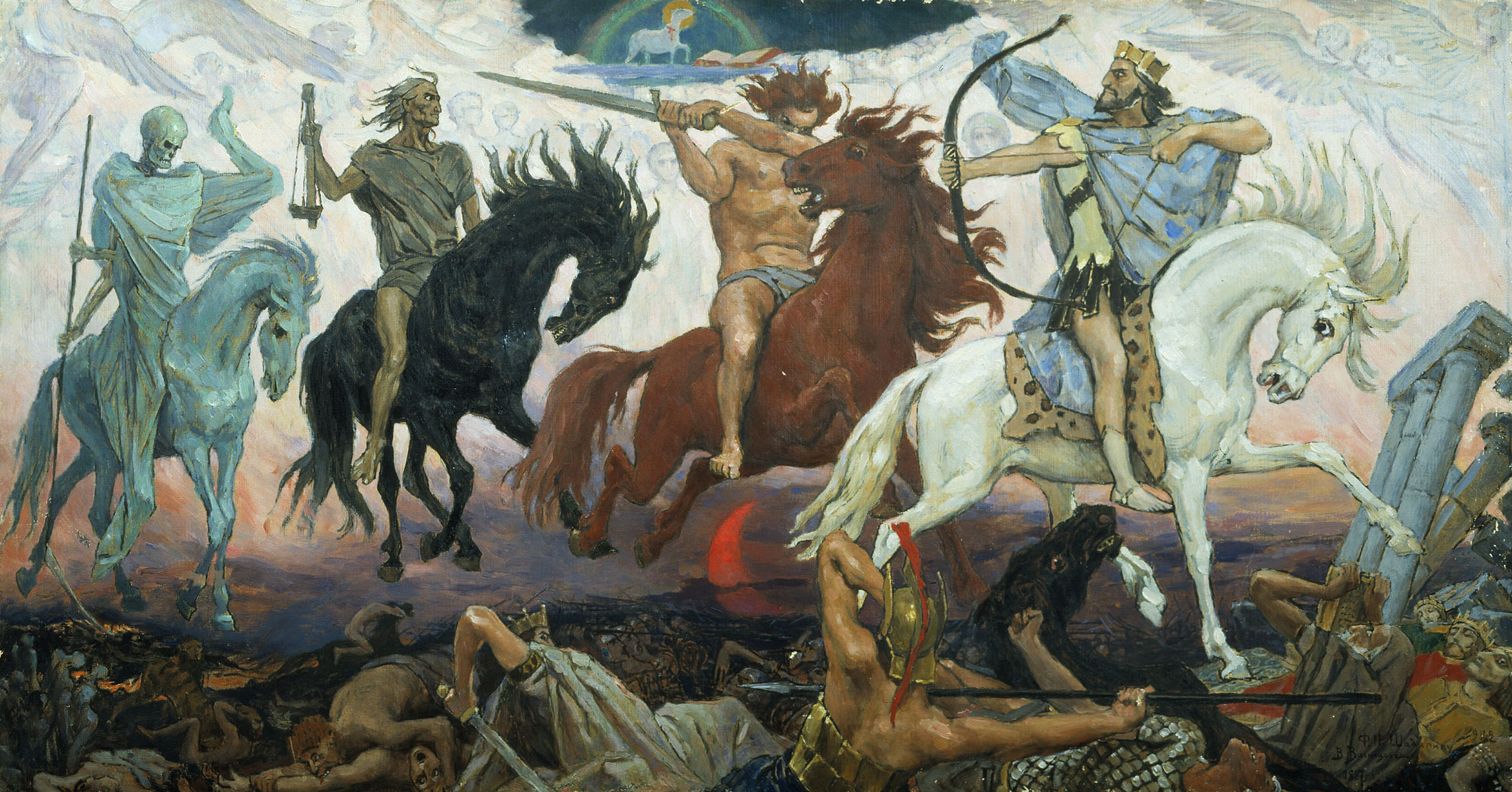
A brief respite followed, and John described the ongoing blockade and party in narrative terms. But this didn't last long, for at the thirtieth hour, the Lamb broke the fourth seal, the seal of Sin. A griffin emerged from the temple of Enlil and announced the fourth doom – the wrath of Sin. By green moonlight, a self-propelled Magilum boat with a horse-carved prow arrived on the Irnina canal and broke through the water gate. It docked in the karum (trading quay) and and unloaded it's occupants. Thirty sickly Sealander warriors, led by the demon Bennu (15), a deputy of Sin and causer of fits, spread out into the city, killing and spreading disease. With this, a plague of palsy spread through the city, and the characters joined the effort to eradicate the green menace.


Lyrics:

And when the lamb 
opened the first seal,
I saw the first Horse.
The Horseman held a bow

Now when the lamb 
opened the second seal,
I saw the second Horse
The Horseman held his sword

The leading horse is white
the second horse is red
the third one is a black,
the last one is a green

The leading horse is white
the second horse is red
the third one is a black,
the last one is a green

And when the lamb 
opened the third seal,
I saw the third Horse.
The Horseman had a balance

Now when the lamb 
opened the fourth seal,
I saw the fourth Horse.
The Horseman was the Pest

The leading horse is white
the second horse is red
the third one is a black,
the last one is a green (16)

NOTES

13. Temtu is the Sumerian name for the god who would later be known as Tiamat. This is a subtle bit of foreshadowing.

14. The Kurgara were third-gender, inhuman, sickle-sword -wielding servants of Ištar. In this scenario a group of them were operating the siege horse.

15. Bennu is one of the disease demons listed in Mythic Babylon, a deputy of the god Sin.

16. White, Red, Black, and Green are all Babylonian colours. White colouring is made from galena, and red from ochre. Black pigment comes from dark grey kohl, and green from malachite.


Four Horsemen of Apocalypse, by Viktor Vasnetsov. Painted in 1887


5. THE LAMB

Here, the band inserted an instrumental track to give The Lamb a theme. The music implies the characters were vainly running around, dealing with emergencies while the Lamb continued her important work. Oddly, the characters themselves were never given musical themes. I understood that they included a Kassite and two Babylonian elite soldiers, an Amorite mercenary scout, and a Diviner from Sumer.


6. THE SEVENTH SEAL

The opening of the remaining seals are described in this song:

THE FIFTH SEAL (Day 3 – 8:00 AM)

At the fortieth hour, the lamb opened the fifth seal, the seal of Ea. At this time, most of the city's weary revelers were asleep, including the characters. When they woke, however, it was to a sound of massive despair, as if the city had uttered a collective moan. The water in the city's canals, its wells, and its abzu basins had retreated, and standing within, cheek by jowl, were the dead. They were grey-skinned, and clothed in white bird feathers. Their mud-caked hands were held high and they wailed, asking for vengeance on the living. The revelers started to panic. Some fell into the the canals and disappeared in the crowds of the dead. It had been Enlil's plan to release the dead into the city at this point, but here, Ea started to diverge from Enlil's script. Silanum called out from the top of the ziggurat, her voice carrying across the city. She bid the dead to wait for the seventh seal. She invited the worshipers of Marduk (among them the player characters) to enter his E-sagila ('House That Raises the Head') temple, and inside they were marked with the symbol of a triangle on their forehead.

Outside in the city, the water returned, covering over the dead, and the followers of Samsu-Ditana managed to get the party going again.

THE SIXTH SEAL (Day 3 – 6 PM)

By the fiftieth hour, Silanum had returned to the sanctum of Marduk and opened the sixth seal – the seal of Enlil. The sun blackened, as if by eclipse. Yet the moon was also in the sky – it had turned red. Meteors fell from the sky, crashing into the city and surrounding lands, causing everyone to take shelter. The earth shook under the feet of the citizenry, causing buildings and more sections of the walls to collapse. The characters spent their time helping people to safety and fighting off attacks through breaches in the wall. Meanwhile, a large crowd gathered in front of the newly build temple to Samsu-Ditana, asking: How much longer must we suffer before our god (Samsu-Ditana) saves us? This situation lasted through the night. Knowing Samsu-Ditana wasn't going to save anyone, the characters took shelter atop the ziggurat.

THE SEVENTH SEAL (Day 4 – 4 AM)

Sixty hours into the campaign, The Lamb broke the Seventh Seal and last seal – the Seal of Anu, father of the gods and lord of heaven. With the breaking of the Seventh Seal, everything stopped. The air was still, and there was complete silence on heaven and earth for half an hour. Nobody could speak, or indeed make any other sound.

Lyrics:

And when the lamb 
opened the next two seals,
We saw the souls,
We saw the martyrs,
We heard them crying,
We heard them shouting,
They were dressed in white,
They'd been told to wait.

The sun was black,
The moon was red,
The stars were falling,
The earth was trembling
And then the crowed
Impossible to number
Carrying flowers,
Shouted amid
The heatless sun
The lightless moon
The windless earth
The colourless sky:
"How much longer will we suffer from hunger?
How much longer will we suffer from thirst?"

And when the lamb opened the seventh seal,
silence covered the sky.


The campaign took a week-long break at this point, so this was left as a bit of a cliff-hanger. I'm going to break here, too, and return next week with part 2.


Sunday, January 19, 2020

How Admu the Sorceress acquired the Spear of Nergal

Last year we ran a few different one-shot scenarios as part of a larger play-testing process for Mythic Babylon. These one-shots were designed to test particular aspects of the system, as well as to generally make sure the game was fun to play. One of those playtests was a combat encounter that pitted one group of player-characters against another. This is how it played out.

Scenario Back Story:

One year, in the drought of summer, a group of priests in the service of the temple of the plague god, Nergal, traveled up the Tigris River from their home city of Mashkan-Shapir. Their purpose was to attend a festival in honour of the Divine Twins in the vicinity of the town of Mardaman. They brought with them the Spear of Nergal, a divine weapon, which was to be used as part of the ceremony. Before they reached Mardaman, the weapon-bearer started behaving erratically, then ran off into the edinnu (steppe) - where he was snatched by a Griffin and carried away with the spear still in hand.

At the head of this group was a Baru (diviner) military commander, who was able to perform a quick divination to determine where the weapon could be found. Armed with this information, they set off in pursuit.

Meanwhile, a Turukkean sorceress named Admu was camping nearby with her posse when they saw the Griffin fly through the sky with a human in his claws. Obviously an omen, the sorceress perceived this to mean that 'she would make acquisitions'. So she, too, set off in chase.

The scenario begins when the group of priests crests one bank of the river (Point P), and the sorceress' group crests another bank (Point S), and for the first time they have the potential for conflict.

Below them lies the river valley. The body of the dead priest – with spear still in hand – lies on an eyot in the river. The griffin splashes in the water nearby, jumping up and down while trying to catch fish. It seems to be having a hard time of it. A muddy oxbow lies nearby, surrounded by reeds and populated by a flock of long-legged waterfowl.


The Characters:

The priest group consists of:

Ibbi-Adad, a Baru, or professional diviner, who also happens to be a military commander in the army of Larsa.

Abdi-Ili, an Exaltation Priest.

Ea-Nasir, an Exorcist.

Turum-Nakti, an Archer and military escort.


The group of Admu the Sorceress consists of:

Admu, a Turukkean Sorcereress.

Ninildu, a Gutean Snake Charmer.

Zutlum and Sudam, two Turukkean Tribesmen hired as escorts. 


How the session played out:

When the two groups arrived at the top of their respective banks, they paused to assess one another. Neither knew who the other people were.

Admu the Sorceress and her group acted first by descending the embankment and approaching the shore opposite the island. They noticed that there were Lion-fish swimming in the water. No wonder the Griffin was having a hard time catching its meal! One of the two tribesmen shot at the griffin and hit it, a mighty fine shot leaving it sorely wounded in its hind-quarters.

The griffin, angered by the arrow, flew into the air and began dive-bombing the two Turukkean archers. Not realizing their danger as it flew into the sky, they wasted an action shooting at the lion fish, but when the griffin screamed out of the air in a dive-bomb they gave it their full attention.

Meanwhile, the group of priests also started to approach, still uncertain as to whether the unknown people were friend or foe. They tried to make peaceful overtures, but the sorceress turned toward them and cast “Hateful Augury” on them. This caused a large flock of marsh birds from a nearby oxbow lake to fly toward them and attack! In a panic, most of that group scattered and fled in various directions - except for Ea-Nasir the exorcist, who cast an incantation of his own: “To Tie a Fly” (which repels vermin and bad omens - we decided it applied here). He cast the spell successfully, but failed to overcome the Sorceress' spell-casting roll, so he was attacked mercilessly by the birds. He tried again on his second action and this time was successful.

The snake-charmer from the sorcery group also tried to get into the spell-casting action by reciting an “Incantation of Nirah” and directed his snake toward the exorcist. His snake was never able to approach, though, because the “To Tie a Fly” incantation repelled it, too.

Once his bird spell was broken, the sorceress cast another spell, “Voice of Kinshaba,” on the exorcist, causing him to be very angry with his own ally, Turum-Nakti the archer. The exorcists chased after the archer, berating him. They ran around until the griffin became the obviously bigger threat – at which time the archer shot an arrow at it.

The two Turukkean tribesmen were meanwhile not faring well against the griffin. After a couple of bad rolls, and no luck points or fortune points to use, they didn't really have a chance They were killed one after the other in two successive rounds, arms torn off by the claws of the griffin. Seeing the trouble, and having scared off the party of priests for now, Admu the sorceress cast “Crippling Pain” on the griffin as it flew above. The spell was successful - but unfortunately hit the left front leg of the creature rather than a wing, chest, head, or abdomen - so it was able to keep fighting from the air. With his magic points now all used up, the sorcerer hid behind a bush, and the snake-charmer slunk down the river bank. The griffin went the opposite way toward priests because their archer had just shot an arrow at it.

Now the priest group, recovered from their fear and sorcerous effects, fought the griffin. The exaltation priest sang an “Exaltation to Erra” liturgical song to boost the entire team by 13%. The baru priest similarly cast buff spells, mostly on the archer. The exorcist tried to draw the attention of the griffin away from the archer and became its next victim. His arm was pulled off in the thing's beak and he collapsed and bled out in the mud. The other three fought on, taking turns drawing the beast attention and diving out of the way. This fight lasted several rounds.

With the griffin occupied elsewhere, the snake charmer saw an opportunity. He drew his second pet snake out of his basket and sacrificed it as a decoy, throwing it into the water as bait for the Lion-fish. Their attention drawn away, he waded across to the eyot and reached the dead body which still grasped the spear. When he tried to pry the dead hand off the spear, though, he was attacked by the passion spirit that had been possessing the priest - and thus found himself locked in spirit combat for the rest of the session.

The sorcerer, now emboldened by the actions of the snake-charmer, also came over to the island. She threw the body of one of the Turukkeans into the river as a decoy and safely crossed over. She reached the spear and grabbed it, ignoring the snake-charmer who was still locked in spirit combat.

By now, the three remaining Nergal cultists had dispatched the griffin (knocking it out with head-shots) and came to the shore opposite the island just in time to see the sorceress grab the spear in triumph. So the exaltation priest cast “Breath of Girra” on the spear, causing it to glow red hot. The sorceress dropped it and ducked down to quench her hand in the water. The exaltation priest was bold enough to cross at this time, but when the others tried, they jumped back out of the water as a lion fish approached. As the exaltation priest was crossing, the sorceress grabbed the spear (taking 4pts of damage to the hand) and flung it across to the far side of the river. The exaltation priest didn't notice this, so when he arrived the sorceress said "keep your spear if you must", and she was able to get away by crossing the river to the far shore while the exaltation priest looked around for the spear. Too late he noticed a small brush fire on the far side where the sorceress had thrown the spear. He watched as the sorceress picked it up (it was no longer red hot, the spell having expired) and ran off, dodging arrows, over the hill.

And that's how Admu the Sorceress came to acquire the Spear of Nergal.

Friday, December 20, 2019

The Great Serpents of Old


The Great Serpents of Old


We think of wyrms and dragons as iconic medieval monsters, and so they are. For sea monsters we turn to ancient instead Greece, the Bible, or the dark ages But the great serpents of legend have very old roots - going back at least to Babylonian times, and probably earlier. They are creatures of such import that they are given individual names, and no two are really alike. But perhaps, like in the story of the blind men and the elephant, they are really all the same creature and we can only appreciate one part at a time. Whatever the case, here are a few Great Serpents whose names you may not have heard before. They come from deepest antiquity.

Sumer and Babylon

Three great horned serpents are known to us from Akkadian literature, their names in some cases coming from Sumerian roots. Though there are several written descriptions, it can be hard to tell them apart as the texts don't always make it obvious which serpent they're referring to.

One of these was Ušumgallu (from Sumerian UŠUMGAL - “The Great Dragon”) who was considered a monster or a demon. Where humans and hybrid creatures were thought to have been made by the gods, monsters and demons had older and more obscure roots. The great serpents were usually thought to have been of offspring of the primordial goddess, Temtu, who in later myth was herself described as a sea monster and given the name Tiamat. Temtu was the encircling salt sea, a mother goddess who gave birth (in some myths) to the lesser gods after mating with the Abzu (subterranean fresh waters). She was later depicted as a sea monster in her own right.

Ušumgallu was counted among the 'warriors' said to have been slain by the god Ninurta, the champion Enlil, king of the gods, and defender of the city of Nippur. The myth recounting this slaying is lost (if it ever existed), but the deed is listed among the god's past exploits in a myth known today as 'The Exploits of Ninurta'. In that myth, Ninurta was also credited with slaying the six-headed wild ram, Anzud the thunderbird, and more. Of his various enemies, only the enigmatic Palm Tree King seems to have escaped.

Ušumgallu can be equated with the lion-dragon - a great horned snake with forelegs and fierceness of a lion. The word 'UŠUMGAL' was sometimes used as a metaphor for a king or a god in order to speak of their greatness. 

The following verse comes from a myth of the god Tišpak, the warrior god and protector of the city of Ešnunna, and translated by Benjamin Foster in Before the Muses: An Anthology of Akkadian Literature.

“The sea produced the serpent.
Enlil has drawn the image of the serpent in heaven.
Its length was twenty leagues, its height was one league.
Its mouth was six cubits, its tongue twelve cubits,
Its horns were twelve cubits.
At sixty cubits it snatches birds.
It draws nine cubits of water when it swims.
If it raises its tail, it darkens the sky
All the gods in heaven fear it.
Go, Tišpak! Kill the lion-serpent!”


A seal depicting the slaying of Ušumgallu or perhaps Tiamat: Source: Wikimedia

Bašmu (Venemous Serpent) was another of the three great horned serpents of Babylonia. Bašmu was said to have two forelegs and wings, and to be sixty double-miles long. Bašmu lived in the sea, and devoured fish, birds, onagers, or humans with equal zeal. It had six mouths, seven tongues, and seven eyes on its belly. The following two texts describe Bašmu - or perhaps the third great serpent called Mušmahhu (Exalted Serpent), about whom little is known but who may have been the seven-headed serpent who was also slain by Ninurta.

“I seize the mouth of all snakes, even the viper,
Serpent that cannot be conjured:
The alabaster burrower,
The fish-snake with rainbow eyes,
The eel, the hissing snake,
The hisser, the snake at the window.
It came in by a crevice, it went out by a drain.
It struck the gazelle while it slept.
It secreted itself in the withered oak.
The snake lurks in a roof beam, the serpent lurks in wool.
The serpent has six mouths, seven tongues,
Seven are the poisonous vapours of its heart.
It is bushy of hair, horrible of feature, its eyes are frightful.
Bubbles ooze from it's maw, it's spittle cleaves stone.”

“The Idiqlat* bore it,
The Ulaya raised it,
It lies under the rushes like a serpent.
Its head is like a pestle,
Its tail is like a pounding tool.
Adad gave it its roar,
Nergal, the descendant of Anu, gave it its slither.
I conjure you by Ištar and Dumuzi,
Not to come near me a league and sixty cubits!”

(Both texts from Before the Muses by Benjamin Foster)

*For context, the Idiqlat is the Tigris River; the Ulaya is the ancient river upon which the important Elamite city of Susa rested. Adad is the Babylonian storm god, Nergal the destructive warrior and king of the Underworld, and Anu is the father of the gods. The goddess Ištar and the shepherd god Dumuzi were famously married until they had a falling out so spectacular it sundered the seasons from one another. 

Bašmu as he appears on the cover of the forthcoming Mythic Babylon setting for Mythras


Hatti and Mitania


In the lands north of Babylonia, another giant dragon-like monster lived. He is called Illuyanka and referred to in both Hattian and Hurrian myths. There are a few different versions of his story, but in one myth, Illuyanka took the eyes and heart of the weather god, Teššub, thus depriving him of his power, but as with so many of the great serpents he was ultimately slain by the god. Some scholars believe that Illuyanka was a metaphorical construct meant to evoke the Gašgaeans, who were a rival people to the Hittites. The name 'Illuyanka' comes from two proto-Indo-European roots - hillu and henge, both of which mean 'snake'. The latin word 'Anguilla' shares the same roots, but written in reverse order.

"The serpent defeated the Storm-god and took his heart and eyes." Source: Wikimedia

India


Yet another legendary great serpent is Poubi Lai, a lake serpent from Manipuri mythology. Poubi Lai is said to have been the embodiment of the spirit of Loktak Lake in northeastern India. In ages past, he was awakened as a manifest spirit of the lake when over-fishing threatened the balance of nature. Poubi Lai ravaged the local villages, so the local king took to appeasing him by offering one basket of rice and one living person for his daily meal. But the people found this situation untenable, and one of the villagers went into the hills to find the great shaman, Kabui Salang Baji, who fashioned a great javelin from an aquatic plant with which to tame the serpent.

Carving of Poubi Lai by Karam Dineshwar Singh. Source: Wikimedia


All these stories make it clear that Great Serpents can be slain by those with special powers, be they gods or heroes. But the task won't be easy, and who will suffer in the meantime? Your own giant serpent quest might require the help of dread shamans, greedy kings, or blind gods. Keep in mind, too, that snakes are said to be immortal - shedding their skins every so often to re-acquire the vigor of youth. What is the secret of that power, and is it shared by the Great Serpents of Old?