Showing posts with label Literature. Show all posts

Sunday, October 31, 2021

This Year, Don't Forget About Lamashtu!

It's Halloween again. Here in North America, the date is marked with costumes and candy. The yards of our city are littered with the symbolism of fear. On my walk earlier today, I spotted Styrofoam tombstones, inflatable undead, plastic dismembered arms, spray-on spider webs (a spider's deathtrap), carrion crows and rats, dancing skeletons, and pumpkins carved with the faces of evil so as to ward it off.

But nowhere did I see an image of Lamaštu, that most feared of Babylonian evils.

Image Source: https://en.wikipedia.org/wiki/Lamashtu


Lamaštu was one of the most dreadful beings of the Ancient Near East. She was sometimes called a demon, but like all Babylonian demons she defies easy classification in modern terms. She was the daughter of Anu, the father of the gods, but she was an outcast and a hybrid. She was often ranked among the Utukku (evil spirits) - not because she was born before the ordering of the universe like they were, but because her evil and rebellious plan to eat mankind for dinner put the gods in mind of evil spirits. For this, she was demoted from the rank of goddess to the rank of utukku, given a canine's head by Enlil, and thrown out of heaven.

There is no catalogue of her activities on earth, though she is quite famous for sucking the breath of newborns from their young bodies, thereby causing crib death. She could be turned away by showing her her own image, or that of the demon Pazuzu.

Those who could afford such things could hire an exorcist to ward her off with an incantation. Several such have been immortalized on clay tablets. If you haven't place a likeness of Lamaštu on your front yard this year, you might consider lighting a few candles, offering up a pure white lamb, and reciting one of these incantations for protection. 
These first two incantations against Lamaštu are quite old and come from early Aššur:

“She is singular, she is uncanny,
She is a child born late in life, she is a phantasm,
She is haunt, she is malicious,
Offspring of a god, daughter of Anu.
For her malevolent will, for her base counsel,
Anu her father dashed her down from heaven to earth,
for her malevolent will, her inflamatory council.
Her hair is askew, her loincloth is torn away.
She makes her was straight to the person without a god.
She can benumb the sinews of a lion, she can still the sinews of a youngster or infant.”
“She is furious, she is terrifying,
She is uncanny, she has an awful glamour,
She is a she-wolf, the daughter of Anu,
Her dwelling in is the grass,
Her lair is in the weeds.
She holds back the full-grown youth in rapid progress,
She yanks out by the breech the premature child,
She brains little babies,
She makes the witnesses swallow the birth fluids.
This spell is not mine; it is a spell of Ninkilim, master of spells.
Ninkarak cast it so I took it up.*"
[Source: Before the Muses: An Anthology of Akkadian Literature
Benjamin R. Foster, Third Edition 2005 CDL Press. 1044 pp.]

*Here I think this refers to Ningirin, goddess of incantations, as the composer of the spell, rather than Ninkilim, goddess of mice and rodents. Ninkarak was a name for the healing goddess, Gula. These lines mean that Ningirin composed the incantation, Ninkarak cast it, and the scribe recorded it.

This third incantation is a little younger and comes from Akkad.
“Anu begot her, Ea reared her,
Enlil doomed her the face of a lioness.
She is furious. She is long of the hand, longer still of the nail.
Her forearms are smeared with blood.
She came right in the front door, slithering over the door frame
She has caught sight of the baby!
Seven seizures has she done him in his belly!
Pluck out your nails! Let loose your arms!
Before he gets to you, valiant Ea, sage of the magical art,
The door frame is big enough for you; the doors are open.
Come, then, begone into the open country!
I will surely fill your mouth with sand, your face with dust,
Your mouth with finely ground mustard seeds!
I exorcise you by Ea's curse: you must be gone!”
[Source: Before the Muses: An Anthology of Akkadian Literature
Benjamin R. Foster, Third Edition 2005 CDL Press. 1044 pp.]


Image Source: https://en.wikipedia.org/wiki/Lamashtu


Another juicy spell can be found in Karen Nemet-Nejat's wonderful introductory book: Daily Life in Ancient Mesopotamia.
“She comes up from the swamp,
is fierce, terrible, forceful, destructive, powerful:
(and still) she is a goddess, awe inspiring.
Her feet are those of an eagle, her hands mean decay.
Her fingernails are long, her armpits unshaven...
The daughter of Anu counts the pregnant women daily,
follows on the heels of those about to give birth.
She counts their months, marks their days on the wall.
Against those just giving birth she casts a spell:
“Bring me your sons, let me nurse them. 
In the mouth of your daughters I want to place my breast!”
She loved to drink bubbling human blood,
(eats) flesh not to be eaten, (picks) bones not to
be picked. (From Lamaštu series, Tablet 1)"
[Source: Daily Life in Ancient Mesopotamia
Karen Rhea Nemet-Nejat, 1998 Hendrickson Publishers. 346pp.]
OK, let's face it: it's probably too late for you to protect yourself for Halloween this year. But if you're still around next Halloween, why not throw up a likeness of Lamaštu on the front lawn? You'll be well protected, and who knows? Maybe even, like the local woman who last year strung headless Barbie dolls like garlands from tree to tree over her front walkway, become the talk of the town!

Saturday, August 28, 2021

A Mythic Babylon Bibliography

Many people have commented on the quality of research in Mythic Babylon, but lamented the fact that we didn't include a bibliography in the book. The reason we didn't was purely for space, and a bibliography is the kind of thing that can easily be published on a forum or a blog just like this one! So, for those who were asking - here's the Mythic Babylon Bibliography. I've broken this down by subject matter, and the books are listed title-first rather than author-first. The list is annotated with my commentary. If a book is listed without comment, it's because it didn't move me enough to remember what I like about it!


ANCIENT NEAR EASTERN VOICES

When writing Mythic Babylon, we distilled the historical and societal information into what we think is a neat package. We didn't have room to include very much in the way of the Babylonians own voices, though, and so the very first I think of when people say they like to further their reading - to the  writings of the ancients themselves. The corpus of literature is rich. Really rich! Rabbit-hole Warning Rich!

But that's where I think you should go first. Here are some fine books that will take you back to the very distant past.

The Ancient Near East: Historical Sources in Translation
Edited by Mark W. Chavalas, 2006 Blackwell. 445pp.

This very fine volume introduces you to the voices of many eras. There are letters, decrees, hymns, and much more. This is real slice of life type stuff, and each piece is richly annotated and introduced.


The Literature of Ancient Sumer
Black, Cunningham, Robson, and Zolyomi, 2004 Oxford University Press. 372pp.

This book includes translations of key texts – a scribal curriculum, really – written in Sumerian. It probably the gold standard for Sumerian texts in English. The book deals with 'literature', which is spends some efforts to define. Letters and other more worldly correspondence are not included here.


Before the Muses: An Anthology of Akkadian Literature
Benjamin R. Foster, Third Edition 2005 CDL Press. 1044 pp.

This cinder block of a volume does for the Akkadian language what the above does for Sumerian, but it's divided up by period so you can see changes over time. Again, a gold standard.


From an Antique Land: An introduction to Ancient Near Eastern Literature
Edited by Carl S. Ehrlich, 2009 Rowman & Littlefield Publishers, 506 pp.

An entertaining volume with some fun commentary from the author. This book covers a spectrum of writings by different people in different languages, with sections on Sumerian, Akkadian, Hittite, Ugaritic, Canaanite, Aramaean, Hebrew, and Egyptian. It's not quite complete (no Hurrian or Elamite, for example) but a rewarding read all the same.


Mesopotamian Chronicles
Jean-Jacques Glassner, 2004, SBL, 365pp

Prophets and Prophecy in the Ancient Near East
Martti Nissinen, 2003 SBL, 296pp

These two books from the Society of Biblical Literature explore particular writings in some depth. The first explores the chronicles of Mesopotamian kings and reveals something about how they viewed their own history. The second explores records of actual incidents of ecstatic prophecy in various time periods and tells us a little about prophets in general. Both recommended if you'd like a deep dive into something specific, but maybe not for the casual reader. Both are reviewed in more depth elsewhere on this blog.


MYTHS

Also in the category of primary voices, we weren't able to include Mesopotamian myths in all their glory – there just wasn't room. And we figured that curious readers could easily look these up online or in books. Here's a collection of publications that feature translations of myths. Some are general, others specific to a particular cycle.

Myths from Mesopotamia
Stephanie Dalley, revised edition 2000, Oxford University Press. 342pp.

Sumerian Mythology
Samuel Noah Kramer, 1972, University of Pennsylvania Press, 130pp

Jealous Gods & Chosen People: The Mythology of the Middle East
David Leeming, 2004, Oxford University Press, 150pp

The above are general studies. The first is a good overall collection for the general reader. The second is an older work by a very important and influential author, now somewhat out of date. The third didn't make a huge impression on me.


A Dictionary of Ancient Near Eastern Mythology
Gwendolyn Leick, 1991 Routledge. 226pp.

Gods, Demons, and Symbols of Ancient Mesopotamia
Jeremy Black and Anthony Green, 1992 The British Museum Press. 192Pp

Both of the above are dictionary type books with various entries in alphabetical order. They don't always agree with one another. Each has entries that the other lacks, so I suppose you'll want them both.


Epics of the Sumerian Kings: The Matter of Aratta
Herman Vanstiphout, 2003 Society of Biblical Literature. 176pp.

The City of Rainbows: A Tale from Ancient Sumer
Karen Foster, 1999, University Museum, University of Pennsylvania, 28pp

The first of the above is a brilliant deep dive into the collection of myths that feature the distant, and perhaps imaginary, city of Aratta. The author provides translations and discussion. The second is a small picture book that tells one of these myths in story-time fashion. It's cute and a labour of love, but there isn't much there to excite the researcher.


The Epic of Gilgamesh
Andrew George, 1999, Penguin Books, 228pp

Gilgamesh: A New English Version
Stephen Mitchell, 2004, Free Press, 290pp

There are many translations of Gilgamesh on the market. The translation by Andrew George is very highly regarded. The retelling by Mitchell is well written and accessible, but not as scholarly.


Inanna: Queen of Heaven and Earth
Diana Wolkstein and Samuel Noah Kramer, 1983, Harper & Row Publishers, 227pp

This collection by the esteemed Sumerologist Samuel Noah Kramer and foklorist Diana Wolkstein deals with the cycle of Inanna myths. It's somewhat dated, but still very enjoyable and worth a read.


RELIGION

Religions of the Ancient World: A Guide
Sarah Iles Johnson, general editor, 2004, The Bellknap Press, 697pp

This is a huge tome of comparative religion, dealing with a wide variety of specific topics and comparing the Sumerians, Akkadians, Hittites, Canaanites, and many more.


Religion in Ancient Mesopotamia
by Jean Bottero, 2001 The University of Chicago Press. 246pp.

A very good overview of the subject.


Ancient Goddesses
Lucy Goodison and Christine Morris eds., 1998, The University of Wisconsin Press, 224pp

More specific to goddesses, with some nice juicy bits for the historical detective.


The Treasures of Darkness: A History of Mesopotamian Religion
Thorkild Jacobsen, 1976, Yale University Press, 273pp

A very interesting and influential work, though perhaps a bid dated now. This offers a more theoretical framework for the religion, rather than a look at the practice. The author has some interesting and compelling ideas.


Gods in the Desert: Religion of the Ancient Near East
Glenn S. Holland, 2009, Rowman & Littlefield Publishers Inc., 309pp

Religions of the Ancient Near East
Daniel C. Snell, 2011, University of Cambridge Press, 179pp

Penguin Handbook of Ancient Religions
Edited by John R. Hinnells, 2007, Penguin Books, 610pp

Three more generalist books to round out the list, all of which have something to offer.


DAILY LIFE

Daily Life in Ancient Mesopotamia
Karen Rhea Nemet-Nejat, 1998 Hendrickson Publishers. 346pp.

This is my favourite 'daily life' book for the Old Babylonian period, and the one I usually recommend.


Handbook to Life in Ancient Mesopotamia
Stephen Bertman, 2003 Oxford University Press. 396pp


Everyday Life in Ancient Mesopotamia
Jean Bottero, 2001 Johns Hopkins University Press. 276Pp

Both of the above are good. The first is broken out by topic, which makes browsing it easier. Unfortunately, it doesn't separate the time periods, so one gets the idea that life never changed over the 4000 year history of the culture. This makes it less useful for research. The second book is a more conventional read and is fine, but not as good as the Nemet-Nejat book.


Ancient Egyptian, Mesopotamian & Persian Costume
by Mary G. Houston, 2002 Dover Books, 190pp.
(essentially a reprint of the original second edition from 1954)

Somewhat dated now, but still has some use for this very specific topic.


Law Collections from Mesopotamia and Asia Minor
Martha T. Roth, 1997, SBL, 283pp

Probably the gold standard book on Ancient Near Eastern laws in English. It covers the known Mesopotamian collections, as well as that of the Hittites. The excerpts of Hammurabi's code in Mythic Babylon do not come from this book, though. For those we turned to The Oldest Code of Laws in the World by C.H.W. Johns, 1903, available on Project Gutenberg.


The Marsh Arabs
Wilfred Thesiger, 1967 Penguin. 233pp.

This is a wonderful travelogue about Thesiger's time living in the southern marshes of the Sealand. It's all to easy to imagine that not much changed between the times of Lugalzagesi and Thesiger.


HISTORIES

King Hammurabi of Babylon
Marc van de Mieroop, 2005 Blackwell Publishing. 171pp.

One of two biographies of Hammurabi that I'm aware of, and the only one I've so far been able to lay my hands on. The other is by Domenic Charpin, and affordable copies have finally come to the market – I anxiously await mine.
 

A History of the Ancient Near East ca. 3000-323 BC, Third Edition
Marc Van de Mieroop, 2015 Wiley Blackwell Publishing. 432 pp.

An excellent survey of Mesopotamian History from 3000 to 323 BC, now in it's third edition..


Mari and Karana: Two Old Babylonian Cities
Stephanie Dalley, 1984 Longman Group Ltd. 218pp.

This book looks at the relationship between the kings of these two cities who were joined by marriage. It's a bit old and possibly hard to find, but I thought it was an excellent little book for revealing some of the politics and events of Subartu.


Letters From the King of Mari
Wolfgane Heimpel, 2003, Esenbrauns, 657pp

This huge book provides a detailed look at the last 12 or so years of King Zimri-Lim's life. It tries to piece together a very complex sequence of events from (usually undated) letters from the Mari archive. It covers some of the same ground as Mari and Karana, but unlike that book, this one is not for casual readers.


The Age of Agade: Inventing Empire in Ancient Mesopotamia
Benjamin R. Foster, 2016 Routledge. 428pp.

This book deals specifically with the Akkadian period of history and with the legacy of that city. If you'd like to use Mythic Babylon but shift the action to the Akkadian period, then I definitely recommend this book.


WEAPONS AND WARFARE

Of the books below, the only two I really recommend are the ones by Hamblin and Howard. The Hamblin book is really comprehensive and covers our period, but stops at the end of the middle bronze age. The book by Howard looks a weapons in detail, from the eye of a re-enactor and re-creator. It's rather dry and has some odd bugaboos, but has information you won't find elsewhere. Both of the Osprey books tend to skirt our period, and the Wise book is now somewhat out of date.

Warfare in the Ancient Near East to 1600 BC
William J. Hamblin, 2006 Routledge 517pp.

Bronze Age Military Equipment
Dan Howard, 2011 Pen & Sword Books. 169pp.

Bronze Age Warfare
Richard Osgood, Sarah Monks, and Judith Toms, 2000 Sutton Publishing Ltd., 165pp

Bronze Age War Chariots
Nic Fields, 2006 Osprey Publishing, 48pp

Ancient Armies of the Middle East
Terence Wise, 1981, Osprey Publishing, 40pp


BOOKS ABOUT CITIES

Mesopotamia: The Invention of the City
Gwendolyn Leick, 2001, Penguin Books, 384pp

The Ancient Mesopotamian City
Marc Van de Mieroop, 2004, Oxford University Press, 269pp

The two books above are generally about Mesopotamian cities and look at them very differently. The book by Leick is one of my favourite history books ever – it gives a detailed look at 7 cities that were prominent at different times in the history of the culture and explains what as unique about them. This gives the effect of one of those 'history of the world in 100 objects' books, where the whole is greater than the sum of the parts. Quite a remarkable piece of writing, really. I'd love to see a sequel with 7 more cities!

The Van de Mieroop book is more a tradition survey of city life, organized by topic.

All of the books below are about specific cities. They vary in scope and some are pretty cursory (Erbil) while others more detailed (Ebla), but they all have something to contribute. Three have been reviewed elsewhere on this blog

Ur: The City of the Moon God
Harriet Crawford, 2015, Bloomsbury, 146pp

A City from the Dawn of History: Erbil in the Cuneiform Sources
John MacGinnis, 2014, Oxbow Books, 128pp

Ebla: An Empire Rediscovered
Paolo Matthiae, 1981, Doubleday & Company Inc., 237pp

Ugarit: Ras Shamra
Adrian Curtis, 1985, Lutterworth Press, 125pp


SPECIAL TOPICS

Philosophy Before the Greeks: The Pursuit of Truth in Ancient Babylonia
Marc Van de Mieroop, 2016, Princeton University Press, 312pp

A book about Babylonian systems of learning which I've reviewed elsewhere on this blog.


The Heavenly Writing: Divination, Horoscopy, and Astronomy in Mesopotamian Culture
Francesca Rochberg, 2004 Cambridge University Press, 331pp

This is mainly about astrology, and mainly about times after the OB period. I don't thin it's for the general reader.


Women in the Ancient Near East
Edited by Mark W. Chavalas, 2014, Routledge, 319pp

This one was a bit disappointing for a rather pedestrian treatment of a subject matter that deserved more.


The Horse, The Wheel, and Language
David W. Anthony, 2007, Princeton University Press, 553pp

A lengthy and detailed look at the cultures of the Pontic steppe and the origins of chariotry.


ATLASES AND GAZETEERS

The Routledge Handbook of The Peoples and Places of Ancient Western Asia
Trevor Bryce, 2009, Routledge, 887pp

This massive tome lists hundreds of Ancient Near Eastern cities with encyclopedic entries, telling where they were, when they were inhabited, and often offering some anecdotes and other information. The book is alphabetical, and there is no chronological index, so if you just want Kassite cities, you have to scan all the entries to find them. It was a hugely useful book for me, and yet despite it's scope, still missed a few rather obvious cities.

Several atlases are listed below. The two best are Roaf and Hunt, probably in that order. Both are large, picture-book type affairs that will have broad appeal. The atlas by Bryce is meant to be a companion to the Handbook mentioned above, but it makes some errors and I found the treatment to be too cursory. The Haywood atlas is a broad survey and lighter than the Roaf and Hunt books.

Atlas of the Ancient Near East from Prehistorical Times to the Roman Imperial Period
Trevor Bryce and Jessie Birkett-Rees, 2016 Routledge. 318pp.

The Penguin Historical Atlas of Ancient Civilizations
John Haywood, 2005, Penguin Books, 144pp

Cultural Atlas of Mesopotamia and the Ancient Near East
Michael Roaf, 1990, Andromeda Books, 238pp

Historical Atlas of Ancient Mesopotamia
Norman Bancroft Hunt, 2004, Thalamus Publishing, 190pp


SURVEYS AND COMPENDIA

The Babylonian World
Edited by Gwendolyn Leick, 2007, Routledge, 590pp

A Companion to the Ancient Near East
Edited by Daniel C. Snell, 2007 Blackwell Publishing Ltd., 538pp

The Sumerian World
Harriet Crawford, 2013, Routledge, 659pp

This category is for broad spectrum histories where the author covers the whole shebang in a single book. The three listed above are compendia, collecting a variety of articles on specific subjects and by different authors, then organizing them in a cohesive fashion. These types of books are better for filling in the corners than as a starting point because the big picture often isn't complete, but each article can give a deep dive into something specific. The effect is rather like what you get when you try to use a pellet gun to cut out the shape of a red star at a carnival midway.

The books below generally make better introductions. I think the first three are the best. The Kriwaczek book surprised me for its quality as it's written by a journalist instead of a historian. These books are listed more or less in order of their utility to a general reader. The ones closer to the bottom cover more specific topics. The Ascalone book is largely a picture book, which some people might find useful.
 

Babylon: Mesopotamia and the Birth of Civilization
Paul Kriwaczek, 2010, Thomas Dunne Books. 310 pp.

The Rise and Fall of Babylon: Gateway of the Gods
Anton Gill, 2008 Metro Books. 192pp.

Early Mesopotamia: Society and Economy at the Dawn of History
J.N. Postgate 1992, Routledge, 367pp

Civilizations of Ancient Iraq
Benjamin R. And Karen Polinger Foster, 2009, Princeton University Press, 297pp

Babylon, John Oates, 1979
Thames & Hudson Ltd., 215pp

The Babylonians: an introduction
Gwendolyn Leick, 2003, Routledge, 182pp

Mesopotamia: Assyrians, Sumerians, Babylonians
Enrico Ascalone, University of California Press, 2007, 368pp

Ancient Mesopotamia
Susan Pollock, 1999, Cambridge University Press, 259pp

Sumer and the Sumerians, Second Ed.
Harriet Crawford, 2004, Cambridge University Press, 252pp

Civliization Before Greece and Rome
H.W.F. Saggs, 1989, Yale University Press, 322pp
This was the first book I read on the subject - the one that started it all. A chance find pulled from my father's large shelf of much more modern history.  

The Ancient Orient: An Introduction to the Study of the Ancient Near East
Wolfram von Soden, 1994, Wm. B. Eerdmans Publishing Co., 263pp

Early Urbanism on the Syrian Euphrates
Lisa Cooper, 2006, Routledge, 313

Ancient Mesopotamia at the Dawn of Civilization: The Evolution of an Urban Landscape
Guillermo Algaze, 2008, The University of Chicago Press, 230pp

Dictionary of the Ancient Near East
Edited by Piotr Bienkowski and Allan Millard, 2000, British Museum Press, 342pp


FURTHER AFIELD

These books cover places outside of our core area and really just scratch the surface.

Dilmun and its Neighbours
Harriet Crawford, 1998, Cambridge University Press, 170pp

The Hittites and their contemporaries in Asia Minor
J.G. Macqueen, 1986, Thames and Hudson Ltd., 176pp

Arabia and the Arabs From the Bronze Age to the Coming of Islam
Robert G. Hoyland, 2001, Routledge, 324pp

Ancient Canaan & Israel: An Introducton
Jonathan M. Golden, 2004, Oxford University Press, 413pp

The Hyksos Period in Ancient Egypt
Charlotte Booth, 2005, Shire Publications Ltd., 56pp

The Lost World of Elam: Re-creation of a Vanished Civilization
Walther Hinz, 1972, Sidgwick & Jackson, 192pp

Ancient Cyprus
Veronica Tatton-Brown, 1997, British Museum Press, 96pp


PAPERS

Rounding out our research, we consulted a number of papers, most of which can be found at Academia.Net or JSTOR. Others were brought to my attention by the Ancient World On Line blog (AWOL) or Ancient Near East Today (ANET). These are presented in no particular order.

Old Babylonian Personal Names, Marten Stol, 1991

Hurrians and Hurrian Names in the Mari Texts, Jack M. Sasson, 1974

Thy name is slave?: The slave onomasticon of Old Babylonian Sippar, Lieselot Vandorpe 2010

Urbanisn and Society in the Third Millenium Upper Khabur Basin, Jason Alik Ur, 2004 Dissertation

The Architectural Defense: Fortified Settlements of the Levant During the Middle Bronze Age, Aaron Alexander Burke, 2004 Dissertation

The Other and the Enemy in the Mesopotamian Conception of the World, Beate Pongratz-Leisten, 2001

Growing in a Foreign World: For a History of the “Meluhha Villages” in Mesopotamia in the 3rd Millenium BC, Massimo Vidale, 2004

Back to the Cedar Forest: The Beginning and End of Tablet V of the Standard Babylonian Epic of Gilgamesh, F.N.H. Al-Rawi and A. R. George, 2014 ASOR

Lists of Personal Names From The Temple School of Nippur, Edward Chiera 1916

Trade, Merchants, and the Lost Cities of the Bronze Age, Barjamovic, Chaney, Cosar, & Hotascsu 2017

Rebuilding Eden in the Land of Eridu, Marco Ramazzotti, 2017 ANEToday Vol 5 No9

Masculinities and Third Gender: Gendered Otherness in the Ancient Near East, Ilan Peled, 2017, ANEToday Vol 5 No2

The Mesopotamian Pandemonium: A Provisional Census, Frans A.M. Wiggerman, 2011

Lists of Personal Names from the Temple School of Nippur, Edward Chiera, 1916

The Ilkum Institution in the Provincial Administration of Larsa During the Reign of Hammurapi (1792-1750 B.C.), Miki Yokoyama Ishikida, 1999

Nuzi Personal Names, Ignace J. Gelb, Pierre M. Purves, and Allan A. MacRae, 1943, University of Chicago Press

Hurrians and Subarians, Ignace J. Gelb, 1944 University of Chicago Press

Storm Gods of the Ancient Near East, Parts I and II, Daniel Schwemer 2008

Transtigridian Snake Gods, F.A.M. Wiggerman, 1997


WEBSITES

In addition to the websites listed in the book, these also proved useful:

Iconography of Deities and Demons in the Ancient Near East, various electronic pre-publication entries.

http://www.religionswissenschaft.uzh.ch/idd/prepublication.php


The Ancient Near East Today offers a website and journal, quite good.

https://www.asor.org/anetoday


If you don't already know about Mythic Babylon and would like to learn more, check out the Design Mechanism Forums. It can be found for purchase at these locations:

Design Mechanism Store / Lulu / DriveThru RPG / Aeon Games (UK)

Tuesday, July 20, 2021

Reading City of Djinns, by William Dalrymple


City of Djinns by William Dalrymple, 1993, 350pp

I first read this many years ago and decided to re-read it again after I finished Rudyard Kipling's Kim with my book club. 

The subtitle, A Year in Delhi tells you pretty much exactly what you get - an account of Dalrymple and his wife's time in Delhi. Like most travelogues, this book features a few of the  trials and tribulations associated with travel and living in a new place, but it offers much more than that. During his stay, Dalrymple delved into the history of the city, and the reader is treated to a book that weaves back and forth in time, telling us what the city as like way back when, an then revealing it again in 1993. 

He covers a wide variety of topics, from historic people and places to the state of modern eunuchry, partridge fighting, and sufism. And the book has some great characters, like partridge aficionado Punjab Singh (whose name is surely an Indian version of Indiana Jones) and the archaeologist B.B. Lal. For a GM like me who likes to infuse their made up worlds with the verisimilitude of the real world, these characters are inspiration gold. It's these characters and some of the situations they find themselves in that I'd like to share with you here today.

One of the more interesting characters in the book is Pir Syed Mohammed Sarmadi, a very successful fraudulent dervish. Dalrymple describes him as -
"A hugely fat sufi with a mountainous turban, and elephantine girth, and a great ruff of double chins, he operates one of the most profitable faith healing businesses in India. One of Sarmadi's forebears was beheaded by the Mughal Emperor Aurangzeb after he wandered into the imperial presence stark naked, shrieking out sufi poetry."
"Everyday, Sarmadi sits cross-legged in his surgery between ten and five, with a short break for a kebab at lunch. It is a small room, and Sarmadi fills a great deal of it. Its walls are lined with powders and sacred texts, framed monograms of Arabic calligraphy and pictures of the Ka'ba at Mecca. There is a continuous queue of folk waiting to see him, and Sarmadi keeps the queue moving. Each petitioner gets about two minutes of his time. Sarmadi will listen, breaking his concentration only to clean his fingernails or to gob into his golden spittoon. When finished, Sarmadi will wave his peacock fan and blow over the petitioner, recite a bit of the Quran, write out a charm or a sacred number, and place it in an amulet. He will then dismiss the supplicant, having first received his fee of fifty rupees, a week's wage for an Indian labourer."
Sarmadi seems to come from a long line of such Sufis, so with a little research, one could round fill out a full faction of them: https://reflectionsofindia.com/2014/07/22/sufisarmad/

Dalrymple also relates some of the stories of past visitors, like Dargah Quli Khan, who visited the city between 1737 and 1741 and reports on the local orgies:
"Hand in hand, the lovers roam the streets, while [outside] the drunken and debauched revel in all kinds of perversities. Groups of winsome lads violate the faith of the believers with acts which are sufficient to shake the very roots of piety. There are beautiful faces as far as the eye can see. All around prevails a world of impiety and immorality. Both nobles and plebeians quench the thirst of their lust here."
Dalrymple later reflects on the modern city: 
"Modern Delhi is thought of either as a city of grey bureaucracy, or as the metropolis of hard-working nouveau riche Punjabis. It is rarely spoken of as a lively city, and never as a promiscuous one. Yet, as I discovered that in December, the bawdiness of Safdar Jung's Delhi does survive, kept alive by one particular group of Delhi-wallahs. You can still find them in the dark gullies of the old city, if you know where to look."

Through Dalrymple, we are  exposed to the 17th Century writings of Niccolau Manucci, son of a Venetian trader who ran away from home at 14 to become a con artist, trickster, and artilleryman in 1660's India. It is partly through his eyes that we learn of Shah Jahan and his in-fighting children Dara, Aurangzeb, Jaharana, and Roshanara.

Of Aurangzeb, he says:
" Although Aurangzeb was held to be bold and valiant, he was capable of great dissimulation and hypocrisy. Pretending to be an ascetic, he slept while in the field on a mat of straw that he had himself woven . . . He ate food that cost little and let it be known that he underwent severe penances and fasting. All the same, under cover of these pretenses he led a secret and jolly life of it. His intercourse was with certain holy men addicted to sorcery, who instructed him how to bring over to his side as many friends as he could with witchcraft and soft speeches. He was so subtle as to deceive even the quickest witted people."


 And Dalrymple tells us of Ibn Battutah, who resided for 8 years in Delhi in the 1330's and 40's with Sultan Muhammad bin Tughluk as a patron. Now, the sultan was a complete bastard (in a pique of anger at the citizens of Delhi, he once gave the entire citizenry 3 days to completely remove themselves to another city 40-days walk away, and when a blind man and a cripple were found still in the city, he had one ejected by catapult, and the other dragged to the new city behind a horse (only his leg arrived). But the sultan liked Battutah (mostly) and at one point decided to send him on a diplomatic mission to China.

Battutah found himself at the head of an entourage of 1000 mounted bodyguards and a long train of camels carrying gifts, such as 100 concubines, 100 Hindu dancing girls, gold candelabras, brocades, swords, and gloves embroidered with pearls. Behind the camels came the most valuable gift of all - a thousand thoroughbred horses from Turkestan.

But only 100 miles into his journey, his train was attacked by Hindu rebels (the country was full of rebels) and Battutah was separated from his group and captured. He managed to escape and re-join his party. At Calicut on the Malabar coast, he loaded everything onto four dhows to sail to China, but lingered on shore for Friday prayers. A sudden storm blew up, grounding and breaking up the boats. The slaves, troops, and horses all drowned. Not daring to return to Delhi, he hightailed it to China on his own.


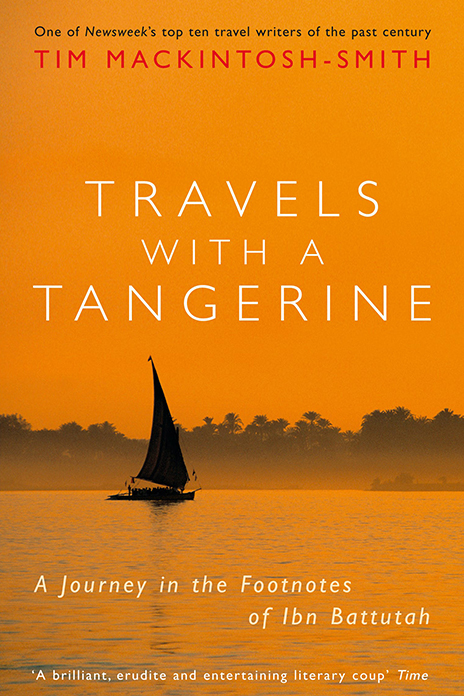
I'll return to Ibn Battutah in a future post, and maybe we'll also look at another travel writer - Tim Mackintosh Smith - who not only wrote an annotated translation of The Travels of Ibn Battutah, but also Travels With a Tangerine: A Journey in the Footnotes of Ibn Battutah.

As for Dalrymple,  he's an evocative writer and I found this book a pleasure to read. It won two awards, has been adapted into a play, and (I'm quite sure, though it doesn't say so on Wikipedia) was turned into a television series in the UK. Here's the Wikipedia page: https://en.wikipedia.org/wiki/City_of_Djinns

Friday, April 23, 2021

Ancient History Book Review

The Ark Before Noah: Decoding The Story of the Flood by Irving Finkel, 2014, 352pp

The Ark Before Noah is a rather charming history book looks at the pre-biblical Mesopotamian flood myth in all its glory. For those who don't know, the author Irving Finkel is the Assistant Keeper of Ancient Mesopotamian script, languages, and cultures in the Department of the Middle East in the British Museum, and is essentially the museum's curator of cuneiform tablets. It's a position he's held for a very long time, and has a wealth of experience, both as a researcher and as a public speaker in the museum.

This experience contributes significantly to the book. Aside from the core subject matter of the flood story, Finkel give us stories of life in the museum and anecdotes from his own early career as a student and educator. Among these is the story of the first decipherment of the Mesopotamian flood text by George Smith (who was so moved by the discovery he screamed and removed his clothes – just like a Babylonian prophet!). There are also stories of later discoveries volunteer translators and Finkel himself, as well as anecdotes from his own earlier career. These personal touches are a welcome (and vanishingly rare in history books) addition to the story Finkel weaves about the evolution of the flood story.


In the audio version, all of this is delivered by Finkel himself in a friendly and conversational manner – he's clearly used to conveying history to a wide audience, and has written several children's books as well as a novel. For gamers – particularly a British gamers – there's an added bonus: Finkel sounds a lot like veteran GM Nigel Clarke, who is himself no stranger to ancient history! So if you ever wondered what it would be like to play in a session GMed by Finkel, play first with Nigel and then give this book a whirl. I haven't played with Nigel myself, but it he breaks role occasionally to tell you stories about his 'cinematically eccentric' colleagues or his flowering from youth to scholar, then the picture will be complete.

“...It was this archaeological fluke that got me the cuneiform job. After signing the official secrets act, I was handed my heavy, pass-port-to-the-nations-treasure key, which is soberly inscribed 'if lost, 20 shillings reward'. The tablet collections in the British Museum defied, and still defy, belief.”
As for the core content, Finkel covers all the basics, giving us the stories of the discovery of the various tablets that reference the flood, their provenance, and their contents, and their relative dates of origin. Of these, two come from the Old Babylonian period, two from the Middle Babylonian Kassite period, two from the Assyrian period, and finally the reference found in the Gilgamesh epic of the Neo Babylonian period. Two tablets are written in Sumerian, the rest are Akkadian.

Finkel also gives us context, describing the relevant bits of Babylonian society, including the idiosyncrasies of writing cuneiform, the role and life of scribes in society, and how writing changed over time. Then he goes through the tablets, spending time on the various episodes to give context to the things described in them. He will ask, for example, what did the ark look like? What kind of boat was it? Then relate what the tablets tell us to what we actually know of ancient Mesopotamian boats. Similarly, he looks at who the flood hero (Atrahasis, Utnapishtim, or Ziusudra, depending on the tablet) might have been, how the god, Enki, conveyed his instructions, and where the boat might have landed afterward.

I started to count off the aspects of Babylonian culture he listed and I compared them to what we included in the Mythic Babylon supplement for Mythras, and soon came to the conclusion that this book offers a nice primer to Babylonian culture. Much of what he talks about is covered in Mythic Babylon, including:
  • The writing and delivery of personal correspondence,
  • Who the Great Gods were
  • The nature of literature and scribal culture,
  • The nature of omens (including the reading of birth defects),
  • Types of divination such as extispicy and leucanomancy,
  • The use of mumbo-jumbo language in spells,
  • The Asu and Ashipu as medical specialists,
  • Gudu priests and other clergy,
  • Dream incubation,
  • Reed houses in the southern marsh,
  • The shape and use of quppu boats, among others, and
  • The source of bitumen for waterproofing.

All of this and more is found in Mythic Babylon.

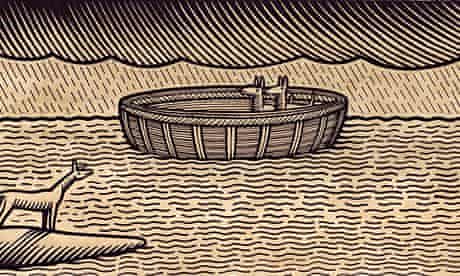
The Ark was a Quppu boat!

 
Finkel also covers a number of things we didn't include in our text, such as the various places people thought the ark had come to rest (A mountain in Urartu, or Mount Nizir, or even Mt Gudi). He discusses the evolution of the flood myth, and the possibility for a trade in 'ark artifacts' not unlike what happened with the bones of saints and pieces of the 'true cross' in the Middle Ages. He spends quite a bit of time developing his theory that the roots of monotheism are to be found in 7th & 6th Century Babylon. He even included a few little gems to surprise me – such as how people can only write cuneiform right-handed, or that truly good scribes were said to 'follow the mouth', or that Hammurabi's Code was written in a deliberately old fashioned style so it could lean on the weight of tradition. And did you know that the word 'disaster' has its roots in the words 'dire' and 'star'? The Dire Star will be the name of my next Fiasco spaceship!

Obviously, I quite enjoyed the book – both as a history buff and as a gamer. Anytime I read a book and learn something that excites me AND I get something I can use in gaming, I consider that a book well read. If the story is also accessible, well-told, and convincing, then that's a five out of five stars book from my perspective, and one I can recommend to my friends.

Saturday, June 13, 2020

Campaign Report: John of Patmos' Mythic Babylon Campaign Part 2: "Apocalypse"

This week we continue with the second and final part of John of Patmos' Mythic Babylon campaign report. See the previous post for part 1 and a link to the music of Aphrodite's Child which you should be listening to as you read this.

7. THE LOWER SEA (17)

While the player-characters were busy in Babylon, something else was going on a few hundred double-miles to the south – a great ripple in the Lower Sea. Silanum's answer to the cries of the people was amplified by Ea and reached even to the Kulullu and Kuliltu people 
(18) who live beneath the waves of the Lower Sea.

Lyrics

I saw the souls
I saw the martyrs
I heard them crying
I heard them shouting
They were dressed in white
they've been told to wait

The sun was black
the moon was red
the stars were falling
the earth has trembling
And then a crowd impossible to number
Dressed in white
carrying palms
shouted amid
the hotless sun
the lightless moon
the windless earth
the colourless sky ...

They'll no more suffer from hunger
they'll no more suffer from thirst
They'll no more suffer from hunger
they'll no more suffer from thirst
They'll no more suffer from hunger
they'll no more suffer from thirst

They heard and heeded the call, but were greatly disturbed by a disturbance from the depths. Something very old was approaching from the open ocean. 

They cried out it's name in warning to the people of Babylon: “An-Dammu! An-Dammu!” (19) The ecstatic prophets of Babylon heard the name and took up the cry in the streets of the city, but few could heed or understand them. After crying their warning, the Mer-people fled into the the shelter of the Abzu (20) where Ea offered them protection.


NOTES

17. In the opera, the band called this track Aegian Sea in order to make the work more accessible to their audience.

18. Kulullu and Kuliltu are the Akkadian names for Mer-men and Mer-women.

19. The name An-Dammu means 'Spouse of Heaven' and can be arrived at by rolling the numbers 6-1-6 on the Babylonian name generator, or by rolling 6-6-6 if one accepts that An-Dammu's city of origin is heaven itself. John of Patmos invented her for the campaign, and saw her as a beast birthed by Temtu (the Sumerian primordial sea, later called Tiamat), who birthed many monsters, demons, and hybrids. An-Dammu is betrothed to Anu, the god of Heaven. In the Middle Babylonian Creation Myth, Marduk would defeat Tiamat to become king of the gods. But in this campaign its her offspring that's defeated.

20. The Abzu is the subterranean water, the domain of Ea.


8. SEVEN BOWLS

We return again to the action in Babylon. After the half-hour of silence that followed the opening of the seventh seal (see Part 1), the statues of the seven great gods animated. They walked from their inner sanctuaries to the gates of their temples, seeming to grow in size as they did so. Each carried a bowl in their left hand and a trumpet in their right. They then raised their trumpets to their mouths and, as the trumpets rang out across the land, overturned their bowls - and the punishment of the gods was poured out.

The god Adad overturned the first bowl, and a mixture of hail, fire, and blood fell to the earth, killing a third of all trees and grasses.

The god An overturned the second bowl and a mountain fell from the sky into the ocean, killing a third of all marine life.

The goddess Ištar overturned the third bowl, and a star fell from heaven and poisoned a third of all rivers and springs.

The god Šamaš overturned the fourth bowl, and a third of the sun, moon, and stars disappeared, creating total darkness for a third of the day and the night.

The god Sin overturned the fifth bowl, and another star fell from the sky and created a great rift in the ground, open to the underworld. Out of this poured a cloud of smoke, and from the smoke came locusts who were "given power like that of scorpions of the earth", and who were commanded not to harm anyone given the "seal of God" on their foreheads. These "locusts" had a human appearance (faces and hair) but with lion's teeth, and wearing breastplates of meteoric iron (21). The sound of their wings resembled "the thundering of many horses and chariots rushing into battle." They flocked to the shore of the Lower Sea, there to await An-Dammu, who was soon to emerge from the sea.

The god Ea overturned the sixth bowl, and the four winds blew the remaining stars out of the sky. When they fall to earth, they were seen to be two hundred million charioteers with flaming wheels and smoke pouring out behind them.

The god Enlil overturned the seventh bowl, and a vision of the Tablet of Destinies was revealed to all – Enlil was shocked to see that the tablet was inside the temple of Marduk, rather than inside his own temple, and that the priestess Silanum was writing furiously within. He unleashed thunder, lighting, and hail to the earth, in order to sweep aside all those remaining in the city, including Silanum – but those marked with the triangle on their foreheads were protected by Ea. So Enlil called forth the beast!

Lyrics:

The first bowl on the earth
the second bowl on the sea
the third bowl on the rivers
the fourth bowl on the sun
the fifth bowl on the Beast
the sixth bowl on the stars
the seventh bowl on the air

And the earth turned grey
the sea turned black
the rivers turned red
the sun turned cold
the Beast turned pale
the stars turned fast
the air turned to poison


NOTES:

21. These locust men were invented by John for the campaign – they aren't mentioned in Babylonian myth, though they definitely fit the idiom For stats, he used modified Pazuzu (a demon) from the book.


9. THE WAKENING OF THE BEAST


This instrumental track in the album turns our attention back to the Lower Sea for a moment, where at last the beast, An-Dammu, is emerging – a monstrous seven headed serpent with poisonous blood!


10. LAMENT


Back on the ziggurat of Marduk, the nameless Gala Priestess character sang out a lamentation for those who were lost, by which to give hope to those who remained.

Lyrics

Alas alas
for the human race
alas
for the kings,
the kings of separation


11. THE MARCHING BEAST


Enlil had seemingly been foiled, because not everyone was dead! He had once again been tricked by Ea and now saw the writing on the Tablet of Destinies. He instructed his step mother, An-Dammu, to march northward at the head of her locust army to put an end to people forever.

But though things looked grim for the followers of Marduk, all was not lost. The stars that had descended to earth as flaming chariots when Ea overturned the fifth bowl were now revealed to be pulled by Apsasus and Aladlammus (22), They are driven by Lahmu (23) and their regiments commanded by the Apkallu (24). Marduk then stepped from his temple and called upon his followers to jump on chariots and join the fight! And so the PCs did!


NOTES

22. Apsasu and Aladlammu are the Old Babylonian period names for the iconic winged, human-headed bulls that guard the homes of the gods. They are female and male respectively – it's not known if there was more than one of each, but in Mythic Babylon we generally assume so.

23. Lahmu are 'hairy-hero-men' hybrids, created by and servants to Ea.

24. The Apkallu are the Seven Sages, originally sent to earth to instruct humans in the arts of the ME (the trappings of civilization.) By the time of Mythic Babylon, they no longer seem to walk the earth, but it is assumed they will return at times of need. 

Source: Oriental Institute of the University of Chicago


12. THE BATTLE OF THE LOCUSTS

13. DO IT

14. TRIBULATION


These three instrumental tracks describe how the army of Marduk and the army of An-Dammu met for a climactic battle on the fields outside Enlil's home city of Nibbur. The player characters, drawn by Ea's fantastical chariots, helped fight the onslaught of locust men.


15. THE BEAST


Fighting the locusts seemed futile, and the player-characters soon realized that the path to victory lay in helping Marduk kill An-Dammu, so they directed their chariots to help find the beast.

Lyrics:

Who can find the Beast?
She's big,
she's bad,
she's wicked,
she's sad
Who can fight the Beast?

She come's,
she goes,
who ever knows ...
Who can fight the Beast?

She's big,
she's bad,
she's wicked,
she's sad
Who can find the Beast?

She come's,
she goes,
who ever knows ...
Who can find the Beast?


16. OFIS


At last, the shape of the giant seven-headed serpent was spotted through the smoke, and Marduk called out a challenge:


Lyrics

Come out, cursed serpent,
because if you don't out yourself,
I will out you! (25)


The two gods squared off, and Marduk drove An-Dammu into the marshes while the players fought off her Umu (26) demon lieutenants. Driven back, An-Dammu disappeared into the bog. The locust army was now defeated, but there is also much injury on the side of humanity, so a temporary withdrawal was called.

NOTES

25. Apparently these words were later placed into the mouth of Alexander the Great in another campaign run by one of the players from this one called Alexander the Great and the Cursed Serpent.

26. Umu demons are 'Roaring Weather Beasts,' creatures of Mythic Babylon that resemble Runequest's whirlvishes.


17. SEVEN TRUMPETS

The great gods rang out seven trumpets again, this time to mark the victory of Marduk and hail him as the new king. Enlil accepted his defeat and agreed to step down as king of the gods, though he would keep his sky domain. The army of Marduk re-grouped at the foot of the Duranki (Navel of Heaven and Earth), the great ziggurat of Enlil in Nibbur.

Lyrics

Ladies and gentlemen
Seven trumpets
the sound of thunder!
Seven trumpets
the threatening anger!
Seven trumpets
the trembling voice!

Seven trumpets
You got no choice!
Seven trumpets
the seven angels!
the seven trumpets
the music changes!

18. ALTAMONT

Marduk now sat on the throne of Enlil in Nibbur and his high priestess, Silanum appeared once gain to recite an exaltation to the assembled followers of Marduk:

Lyrics:

This is the sight we had one day
on the High Mountain
We saw a lamb with seven eyes
We saw a beast with seven horns

and a book with seven seals
Seven angels with seven trumpets
and seven bowls filed with anger

Those are the pictures
of what was
of what is
of what has to come

We are the people
the rolling people
the why people
the waiting people
the wanting people
the tambourine people
the alternative people
the angel people

19. THE WEDDING OF THE LAMB

Following her song, Silanum (“The Lamb”) was symbolically married to Marduk (The Shepherd), and the god and his people were formally united.


20. THE CAPTURE OF THE BEAST

One final task was given to the players – to enter the swamp and capture the beast, and bring her back to Nibbur to face the punishment of the gods. They headed to the marsh at the head of a posse of Ea's inhuman servants and followed her to her lair. She was much diminished by this time, but still dangerous (27). Because of her Melammu (28), the players needed to make willpower tests just to approach her.


NOTES

27. For this encounter, John used the statistics for Mušmahhu, the great seven-headed serpent. 

28. Melammu ('Frightening Splendour') is the aura that surrounds gods and certain other beings.


21. INFINITY

After fighting for a time, with both sides suffering significant injuries, The Beast opened a dialogue with the player-characters, attempting to get them to her side. They allowed her to speak while they also caught their breath. She explained that she could not be killed; that she was primordial. She existed before the gods, and would come again after them. Her role on the planet was to herald change and create new orders, not to be enslaved.

Lyrics:

I was
I am
I am to come

The players tested their purity to decide how to react to the beast, and decided to let her go. It was the Gods and Samsu-Ditana who brought all this about, afterall. The beast needed to exist in order to redress the imbalance. So they let her go, and returned to Nibbur to meet their own punishment for defying the gods.


22. HIC AND NUNC

The characters returned to Nibbur to be tried by the gods, and the stated their case before the great council of Marduk. Afterward, Silanum came to their cell to tell them they had been pardoned. She made a final speech, and sang a song of praise to the characters who helped save the world and usher in the new order. 

With this, the campaign came to a close. In his de-briefing afterwards, John of Patmos revealed that the Kassite character's offspring with Silanum would form the next ruling human dynasty of Babylon.

Lyrics:

Here and now!
Here and now!

Fixing the ceiling
I got a feeling
- sing it again!

Here and now!
Here and now!

Show me the season,
give me the reason
sing it again!

Here and now!
Here and now!

Whisper a meaning
nobody's leading
sing it again!
sing it again!

Here and now!
Here and now!

I got a feeling
somebody's missing
sing it again!
sing it again!

Here and now!
Here and now!


23. ALL THE SEATS WERE OCCUPIED

The campaign ended, but the rock opera concludes with two remaining tracks. This one summarizes the campaign, hitting the highlights and commending the GM on not killing a single player-character.


24. BREAK

And finally, a goodbye from the group as they planned to split up for the summer at the end of term. In fact, they were never able to get everyone together for a game again. Some have argued that every campaign can only exist once, and the Apocalypse of John of Patmos can never be re-created. Can't it? Do it!

Lyrics:

Bye bye, my friend, goodbye
With a lie
you forget and break it

You make it
You make it
You make it
You make it

Cry in my empty room
and we try
to forget and break it

Fly
high
and then
you make it

[interlude]

Bye bye, my friend, goodbye
With a lie
you forget and break it

You make it
You make it
You make it
Oh you make it
Oh, ah. ah.


Do it!


Saturday, May 4, 2019

Book Review: Mesopotamian Chronicles by Jean-Jacques Glassner

Book Review: Mesopotamian Chronicles 
by Jean-Jacques Glassner, 2004, 365pp


This issue from the Society of Biblical Literature is a translation and update of a previous work by the author published in French. It's a survey of the published chronicles (a particular genre of literature that concerns itself with the documentation of events over time) which were originally written in the Sumerian, Akkadian, Babylonian, and Assyrian languages. Their writing spans a period of about 2000 years from the time of the Third Dynasty of Ur (c.2100 BC) to the Seleucid period (c.300 BC). The time periods these chronicles purport to cover are the same, but in some cases they stretch back to the dawn of humanity, before the mythical flood.

About two-thirds of the book is devoted to the translations and transliterations of some 53 unique texts, most of which are fragmentary - many extremely so. The remaining third is devoted to a discussion of the nature of the texts (how they're classified, what characteristics they share, who wrote them, and why), and to a discussion of Babylonian and Assyrian thought on the nature of origins.

Most interesting in this first third of the book, though, is the author's thesis on the Babylonian view of the nature of history, and why they considered it valuable. According to Glassner, Babylonians didn't see history as linear, but cyclical. Their chronicles, and especially the earliest, the Chronicle of the Single Monarch, which attempts to relate for the first time the earliest history of the people going back thousands of years, is predicated on the idea of cycles.

The greatest cycle was that of the 'flood', for which original Sumerian word apparently refers to a 'meteorological event that is a weapon of the gods' and could relate to both a great storm or an invasion. 'Deluge' might be a better translation. In any case, it refers to a wiping clean of the land by something of divine origin that flows over the land. The mythical 'Flood' is one example. The invasion of the Gutians at the end of the Akkadian era is another.

Within the flood cycles are dynastic cycles, in which the high kingship of the ruling city is passed to another king of the same city. When the dynastic cycle ends, rulership is passed to a new dynasty in the next city. Within each dynasty is another another nested cycle - that of individual of kings. Kings rule for cycles of years, which are made of a cycle of months, which are made of days, which are made of hours.

Babylonian linear history therefore looks something like this:
Hours are nested within
Days, are nested within
Months, are nested within
Years, are nested within
The Reigns of Kings, are nested within
The Dynasties of Cities, which are nested within
Divine Deluges.

The purpose of knowing the cyclical history (which is more important than the linear history) is so that any given king can figure out if he's going to be the one at the end of a cycle or not. Because nobody wants to be that guy.

As usual when I review these books on ancient history, I like to provide a few excerpts to show what I find so fascinating, and to illustrate how I might apply them to games and world-building. Here are some things that particularly caught my eye:

REPLICATING THE CITY
From the discussion of page 87:

"The Replica of Babylon: Two chronicles explained the tragic end of Sargon of Akkade by reference to a sacrilege he had committed by removing soil from Babylon and reconstructing a replica of the city elsewhere. Should we see here an allusion to the Assyrian practice of transporting soil from conquered territories to be trampled daily under the feet of its conquerors? Rather, the comparison with Nabonidus seems more likely, as he was reproached for wanting to construct at Tayma, in the north of the Arabian peninsula, a replica of the palace of Babylon."

Both of these suggestions are compelling to me. The former is basically the epitome of the act of what we would consider an evil empire - adding injury to defeat. The latter is interesting in a society where cities belong to their gods - for a human king to want to build a replica of a divine city would be seen as the height of hubris. Maybe, in your homemade world, it's the latter act that causes the 'deluge' which takes the form of the invasion of someone who would trample your soil daily - that's an interesting cycle in and of itself.

THE SUBSTITUTE KING
Here's an actual chronicle entry. This was written in the late Babylonian period (7th century) but refers to a much earlier event in the 20th century BC. This instance, which takes place during cycle of the first dynasty of Isin, describes the practice of the substitute king, in which a king receives a warning by omen or prophecy that he will die, and so places a courtier or some other poor sap on the throne for a short time, while he takes the position of 'gardener'. Usually, if nothing happens naturally to the substitute king, he is killed and the prophecy is fulfilled. Then the rightful king retakes his place. In this instance though, events unfolded otherwise:
"King Erra-imitti ordered Enlil-bani, the gardener, to sit on the throne as royal substitute and put the crown of kingship on his head. Erra-imitti died in his palace while swallowing soup in little sips. Enlil-bani sat on his throne, did not resign, and was elevated to the royal office."

In this case, the rightful king died while he was playing the gardener. The substitute refused to step aside, and kept the throne. I have no idea what the significance of the 'little sips' is, but I love the detail. This would make a superb set up for a one-shot game. Imagine if the player-characters were sent on a diplomatic mission, only to find that the king they were supposed to treat with had been replace by a temporary substitute. Would they treat with the substitute, or try to find the real king, who is hiding as a 'gardener'. Then, when they do find the real king, he dies, choking on soup - maybe right in front of them. Imagine the look on the player's faces.

ACTS OF A DERANGED KING
In another late chronicle, we are treated to the events that chronicle the mental or moral breakdown of a king of the Chaldean dynasty of Babylon, Nabu-shuma-ishkun. He commits all kinds of acts that would be considered atrocities today - maybe they were then, too, but people felt powerless to stop them.

"Unshaven, he mutilated (the fingers of) his apprentice scribe, and, wearing fine gold, he entered into Bel's (Marduk's) cella of offering..."
"A leek, a thing forbidden (taboo) in the Ezida (temple), he brought to the temple of Nabu and gave to the one "entering the temple" (a temple functionary)."
"In (only) one day, he burned alive sixteen Cutheans (citizens of the city of Cutha) at Zababa's gate in the heart of Babylon."
"The man Itagal-il of the town of Dur-sha-Karhi , which is on the banks of the Euphrates, came into his presence and swore agreements and oaths, but he committed insult and unspeakable slander that are forbidden of princes against him and counted his town as booty."
"In the sixth year, he turned his attention toward the Esagila , the palace of Enlil of the gods, with a view to restoring it, but the possessions of the Esagila (as much as was there, that earlier kings had donated) he took out, gathered them into his own palace, and made them his own: silver, gold, choice and priceless stones, and everything that befits a deity, as much as was there. According to his good pleasure, he made offerings of them to the gods of the Sealand, or the Chaldeans, and of the Aramaeans. He would adorn the women of his palace with them and would give them to the kings of Hatti and Elam as signs of respect."

Stealing from the gods, cursing, and bringing leeks into the temple! Now there's a king just asking for a deluge!

SUMMARY
Like so many books that survey ancient literature, this book holds some serious gems. You have to sort the wheat from the chaff, but here the author helps us do that and gives us some synthesis. He could have just presented the chronicles as they were and left us to draw our own conclusions, but he didn't. His analysis really brings the chronicles alive and reveals the wonder of the ancient world.