Sunday, June 7, 2020

Campaign Report: John of Patmos' Mythic Babylon Campaign Part 1: "Revelation"

For this entry I thought I'd share an early campaign report for the forthcoming Mythic Babylon. This was run in Greece by a GM known on the web as 'John of Patmos.' The campaign was written up by the GM in Greek and I understand has been translated a few times and published in some anthologies of similar campaign reports, but I find it a bit convoluted. So in this case I thought I'd turn to a separate campaign report prepared by the players, which is a lot more concise. The players were a group of musician friends who released their report in the form of a prog rock opera (I know right? Who does that?! (1)) called 666 . It's really good – you can find it on youtube if you search for Aphrodite's Child 666. So what follows is a summary of the campaign based on the rock opera, with a bit of additional material from John of Patmos' version. I hope you enjoy it as much as I did.


HISTORICAL BACKGROUND

The campaign begins in Babylon. Rather than use the default start date presented in Mythic Babylon, John decided to run the game in the year 1595 BC at the very end of the Old Babylonian Period. Samsu-Ditana ( https://en.wikipedia.org/wiki/Samsu-Ditana ) was the King of Babylon at the time, and Babylon a city that had controlled access to the Tigris and Euphrates rivers (both important trade routes) in central Babylonia for nearly 200 years. Their rivals at this time were the Kingdom of the Sealand to the south, ruled by King Gulkišar, the Kingdom of Elam in the east, ruled by Širtuh, King of Susa, and the Hittites to the north under King Mursili, who is historically credited with bringing about the first fall of Babylon.

NOTES


1. Okay, my friend Clash Bowley does this, but he's the only one I know.

CAMPAIGN SUMMARY


The events below are presented to coincide with the named tracks on the 666 album. 


1. THE SYSTEM (THEME)

This is the opening track, and it reveals the theme of the campaign, which is destruction and renewal, The lyrics of which quote the GM, John of Patmos who often said 'This is the system to f*** the system', by which he meant 'We'll use Mythras (the game system) to destroy Babylon (the political system).'

2. BABYLON

To open the campaign, John described the scene of a grand week-long festival to that was called celebrate King Samsu-Ditana's ascension to godhood. It was once a custom for kings to ascend to godhood; it was started by King Naram-Sin of Akkad and continued by the Kings of Ur and later of Isin and Larsa; the first two of these fell cataclysmic destruction, and that latter were absorbed by their neighbours. The practice was dropped by the Kings of the first dynasty of Babylon. This campaign is based on the premise that the last king of the dynasty, Samsu-Ditana, was vain enough to re-invoke the practice and thus bring about the end of Babylon.

The opening scene reveals how, masked by all the pomp and circumstance of the festival, the city and it's institutions are actually crumbling from neglect.
Lyrics:

Fallen fallen fallen
is Babylon the great!
Space is getting bounded,
time is getting late! (2)

Masters fall and wonder,
people rise and wait (3)
Fallen fallen fallen
is Babylon the great!

You don't need a coin (4)
I don't have to shine
We don't know the reason

But I need you madly
and you need me too
and we need each other... (5)
and we need each other...

NOTES: 

2. This is a reference to how Babylon has lost it's shine, its greatness has fallen away. But it's also a clever bit of foreshadowing. 'Space is getting bounded' refers to Babylon's shrinking territory, and time is certainly late – historically Samsu-Ditana was the last king of his dynasty. 

3. 'Masters fall and wonder' is here a reference to the nobility of Babylon falling to the ground in worship of their new 'god' Samsu-Ditana. The people, on the other hand, or more skeptical and fearful.

4. 'You don't need a coin' is quite true – obviously the players found it noteworthy that coinage hadn't been invented yet.

5. A reference to both the vanity and neediness of King Samsu-Ditana and the GM himself, perhaps? But it is a truism that gamers need each other – this is a social hobby, afterall.


3. LOUD LOUD LOUD

As I mentioned, the opening scene was one of pomp and circumstance – a grand festival to inaugurate the king. If you've ever read 'The Curse of Agade' 
( https://www.ancient.eu/article/748/the-curse-of-agade-naram-sins-battle-with-the-gods/ ) you'll know this is likely to be an affront to the gods. And to make matters worse, the great god Enlil doesn't like having his rest disturbed by noisy humans ( https://www.ancient.eu/article/227/the-atrahasis-epic-the-great-flood--the-meaning-of/ ).

So, while all this pageantry was happening in the streets, Enlil was plotting once again to rid the world of Humans. And once again, the crafty god Ea decided to work behind the scenes to prevent this from happening. John imagined Ea thinking 'This is the last time I will help Enlil destroy the humans. I will depose Enlil as king of the gods and place my own son, Marduk, god of the city of Babylon, on the throne. That way I will never have to save humankind again.'

So, when Enlil directed Ea to bring about the destruction, he put his plan into effect: Ea instructed Marduk's priestess, Silanum (her name means 'Spring Lamb'), to unlock the box containing Tablet of Destinies which records the grand plan of the gods for the future of everything. He told Enlil he would unlock the tablet to write the end of human-kind, and on the surface that's what this looked like, but the tablet was really going to be used to re-write out of the position of King of the Gods.

This all happened behind the scenes, of course. The player-characters discovered bits of this plan via prophecy during the campaign which lead up the the apocalypse and the final revelation at the climax.

So, back to the festival, which this track continues to describe. Here John of Patmos described the pageantry in more detail and the players were introduced to the city of Babylon. There were some good role-playing opportunities with various locals, including nobles, priests, craftspeople, and commoners. This scene ends at 6pm - sunset on the first day. The band described it thusly:


Lyrics:

The day the walls of the cities will crumble away (6)
uncovering our naked souls, (7)
we'll all start singing,
shouting, screaming
loud, loud, loud, loud

The day the circus horses will stop turning around, (8)
running fast through the green valleys,
we'll sing and cry and shout
loud, loud, loud, loud

The day the cars will lay in heaps (9)
their wheels turning in vain,
we'll run along the empty highways
shouting, screaming, singing
loud, loud, loud, loud

The day young boys will stop becoming soldiers,
and soldiers will stop playing war games, (10)
we'll sing and cry and shout
loud, loud, loud, loud

The day will come up
that we'll all wake up
hearing and shouting of joy
and shouting together with the freaks (11)
loud, loud, loud, loud

The day the world will turn upside down
we'll run together round and round
screaming, shouting, signing
loud, loud, loud, loud
loud, loud, loud, loud (12)

NOTES

6. Babylon's buildings and walls were made from mud brick and in a bad state of decay from neglect. This was in part because all the festivals the king insisted on holding were keeping the builders from their work. Mud-brick construction is prone to decay, so in some sense the walls were always crumbling, except when kings organized a work crew to re-construct them. But as is implied in verse four, the citizens of the city had been exempted from their normal conscription duties, so there's no-one to repair the walls, and no militia to deal with an emergency. Woe betide the unprepared king who lets his walls collapse just before an apocalypse!

7. Every person had an etemmu, or 'ghost', who can linger in the surface world if their descendants don't treat them well after death. The dead were either buried in cemeteries or under the floor of the family home. Neglect of either could uncover these naked souls and free them to wander the streets. This is exactly what was happening in the city, and the scene ends with a dramatic spirit combat between the characters and some ghosts.

8. This is a reference (with some poetic license) to the absence of horses being sacrificed for the dedication of temples. Without sacrificial horses, temples were not renewed. The houses of the gods were crumbling like everything else. The only new temple was the one dedicated to Samsu-Ditana

9. Typo, here – 'carts' is of course what is meant, their wheels turning in vain in the mud. And note also that the highways (trade routes) were empty - a bad sign when you need to trade your excess grain for metals with which to make weapons or silver currency.

10. Young men were in fact conscripted into war in Mythic Babylon, and also sent to perform other tasks like repairing dilapidated civic structures such a defensive walls and temples. But, to appease troublesome citizens, some cities exempted their citizens from these duties. In this campaign, Babylon was one of them – hence the poor state of the army, temples, canals, and city walls.

11. 'Shouting together with the freaks' is a clear reference to the ecstatic prophets, who were taking to the streets in this episode and later ones to pronounce doom on the city. The characters encountered at least one in this opening session.

12. Some strong fore-shadowing here. This was the day the world started turning upside down. The crowd thundered and Enlil fumed on his mountaintop.


4. THE FOUR HORSEMEN

This track describes several of the early sessions of the campaign into a single song. Things were starting to go bad and the player-characters were sent on various trouble-shooting missions. Here's the summary of events:

During the festival described in the previous session, various gods arrived from other cities – Adad from Karkara, Ištar from Kazallu, Šamaš from Sippar, Sin from Ur, Ea from Eridu, Enlil from Nibbur, and Anu from Uruk, each with their own pageant.

Meanwhile, Marduk's high priestess, Silanum ('the lamb'), was sequestered in the inner sanctum of Marduk's temple upon the E-temenanki ('House of the Foundation of Heaven and Earth') Ziggurat. She started break the seals on the box that contained the Tablet of Destinies, by which to open the fate of the world to change. Each seal required elaborate rituals to unlock, so the process took several hours to complete. Of course, the characters didn't learn this was happening until much later – they were occupied with other things.

From the start of the game, John of Patmos started what he called his 'doomsday clock' to time events. This 'clock' was based on Babylonian numerology, which assigned numbers to the most important gods like this:

10 for Adad, the bringer of storms,
15 for Ištar, the temptress and goddess of battle,
20 for Šamaš, the sun,
30 for Sin, the moon,
40 for Ea, the god of wisdom and maker of humans,
50 for Enlil, king of the gods, and
60 for Anu, father of the gods.

He used this to time the events of play. The first four of these are described in in this song:

THE WHITE HORSE (Day 2 - 4:00 AM)

Ten hours into the festivities, Silanum broke the first seal on the table of destinies – the seal of Adad. An uridimu (a lion with the head of a man) emerged from the temple of Enlil and announced the wrath of Adad. This was accompanied by a storm with driving rain, thunder, and lightning. Prophets cried out about this doom in the city streets, but people thought this was part of the show at this all-night party.

The storm masked the presence of Hittite raiders who were descending on the city from the north. This was an advance party, riding in chariots drawn by white horses and wielding bows. The characters were part of a group sent out to try to prevent the raiders from approaching the city. They managed to fend them off, but the Hittites didn't leave – they made a camp not far from the city.

THE RED HORSE (Day 2 - 9:00 AM)

Fifteen hours into the festivities, Silanum broke the second seal, the seal of Ištar. A kusarikku (bull-man) emerged from the temple of Enlil and announced the arrival of the second doom: The army of the Sealand had arrived, led by King Gulkišar. They came up the Euphrates River on thousands of barges and they begin to assemble their siege equipment, including a monstrous red-painted siege-horse called Zu Gusiaš Temtu ('The Tooth of Temtu' (13)), which was set to work on the weak southern walls of the city. The players characters were joined a sortie sent out to try to disable it and it's inhuman Kurgarra (14) operators. With the destruction of the red horse, the troops surrounding the city settled in for the long haul and blockaded the city, but did not attempt to breach its walls. Again, the citizenry hardly noticed.

THE BLACK HORSE (Day 2 – 2:00PM)

The citizens of Babylon continued to celebrate the ascension of Samsu-Ditana, oblivious to the threats outside the city walls. At the twentieth hour, the Lamb broke the third seal, the seal of Šamaš. Šamaš wass the all-seeing sun, and also the god of justice, fair dealings, and by consequence, of trade. With the breaking of the third seal, a Lahmu (hairy-hero-man) emerged from the temple of Enlil into the unusually scorching afternoon sun and announced the next doom on the city.

An embattled merchant caravan, led by an Elamite trader bearing a scale and leading a trail of black pack horses, managed to break the blockade and enter the city. The merchant spoke of poisoned wheat causing mass death in the surrounding lands, and warned against allowing the forthcoming feast to continue. The characters joined the effort to round up and destroy all the bread they could find before people could eat it – a move heavily opposed by the festival organizers and the king's troops.


THE GREEN HORSE (Day 2 – Midnight)

A brief respite followed, and John described the ongoing blockade and party in narrative terms. But this didn't last long, for at the thirtieth hour, the Lamb broke the fourth seal, the seal of Sin. A griffin emerged from the temple of Enlil and announced the fourth doom – the wrath of Sin. By green moonlight, a self-propelled Magilum boat with a horse-carved prow arrived on the Irnina canal and broke through the water gate. It docked in the karum (trading quay) and and unloaded it's occupants. Thirty sickly Sealander warriors, led by the demon Bennu (15), a deputy of Sin and causer of fits, spread out into the city, killing and spreading disease. With this, a plague of palsy spread through the city, and the characters joined the effort to eradicate the green menace.


Lyrics:

And when the lamb 
opened the first seal,
I saw the first Horse.
The Horseman held a bow

Now when the lamb 
opened the second seal,
I saw the second Horse
The Horseman held his sword

The leading horse is white
the second horse is red
the third one is a black,
the last one is a green

The leading horse is white
the second horse is red
the third one is a black,
the last one is a green

And when the lamb 
opened the third seal,
I saw the third Horse.
The Horseman had a balance

Now when the lamb 
opened the fourth seal,
I saw the fourth Horse.
The Horseman was the Pest

The leading horse is white
the second horse is red
the third one is a black,
the last one is a green (16)

NOTES

13. Temtu is the Sumerian name for the god who would later be known as Tiamat. This is a subtle bit of foreshadowing.

14. The Kurgara were third-gender, inhuman, sickle-sword -wielding servants of Ištar. In this scenario a group of them were operating the siege horse.

15. Bennu is one of the disease demons listed in Mythic Babylon, a deputy of the god Sin.

16. White, Red, Black, and Green are all Babylonian colours. White colouring is made from galena, and red from ochre. Black pigment comes from dark grey kohl, and green from malachite.
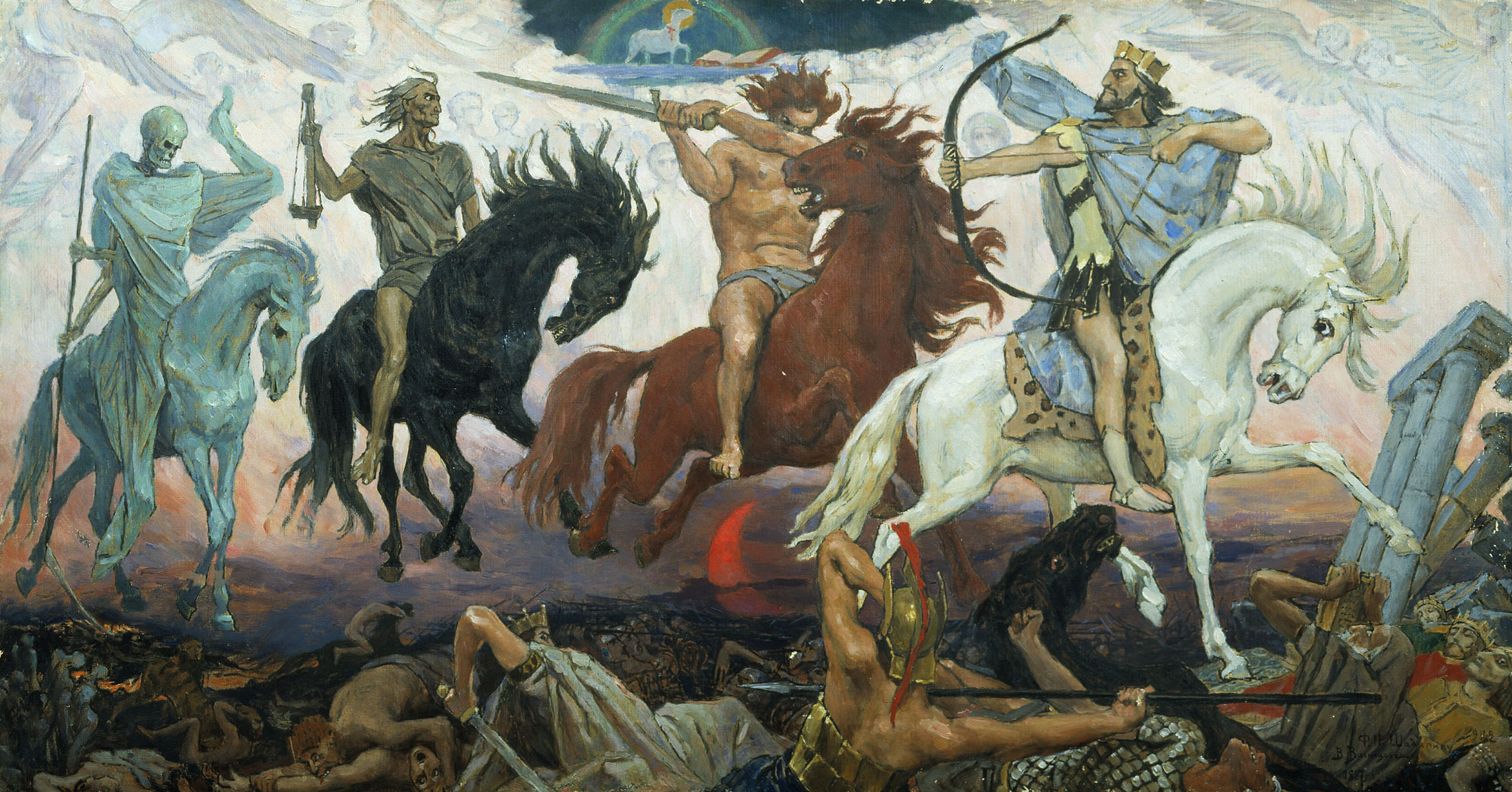


Four Horsemen of Apocalypse, by Viktor Vasnetsov. Painted in 1887


5. THE LAMB

Here, the band inserted an instrumental track to give The Lamb a theme. The music implies the characters were vainly running around, dealing with emergencies while the Lamb continued her important work. Oddly, the characters themselves were never given musical themes. I understood that they included a Kassite and two Babylonian elite soldiers, an Amorite mercenary scout, and a Diviner from Sumer.


6. THE SEVENTH SEAL

The opening of the remaining seals are described in this song:

THE FIFTH SEAL (Day 3 – 8:00 AM)

At the fortieth hour, the lamb opened the fifth seal, the seal of Ea. At this time, most of the city's weary revelers were asleep, including the characters. When they woke, however, it was to a sound of massive despair, as if the city had uttered a collective moan. The water in the city's canals, its wells, and its abzu basins had retreated, and standing within, cheek by jowl, were the dead. They were grey-skinned, and clothed in white bird feathers. Their mud-caked hands were held high and they wailed, asking for vengeance on the living. The revelers started to panic. Some fell into the the canals and disappeared in the crowds of the dead. It had been Enlil's plan to release the dead into the city at this point, but here, Ea started to diverge from Enlil's script. Silanum called out from the top of the ziggurat, her voice carrying across the city. She bid the dead to wait for the seventh seal. She invited the worshipers of Marduk (among them the player characters) to enter his E-sagila ('House That Raises the Head') temple, and inside they were marked with the symbol of a triangle on their forehead.

Outside in the city, the water returned, covering over the dead, and the followers of Samsu-Ditana managed to get the party going again.

THE SIXTH SEAL (Day 3 – 6 PM)

By the fiftieth hour, Silanum had returned to the sanctum of Marduk and opened the sixth seal – the seal of Enlil. The sun blackened, as if by eclipse. Yet the moon was also in the sky – it had turned red. Meteors fell from the sky, crashing into the city and surrounding lands, causing everyone to take shelter. The earth shook under the feet of the citizenry, causing buildings and more sections of the walls to collapse. The characters spent their time helping people to safety and fighting off attacks through breaches in the wall. Meanwhile, a large crowd gathered in front of the newly build temple to Samsu-Ditana, asking: How much longer must we suffer before our god (Samsu-Ditana) saves us? This situation lasted through the night. Knowing Samsu-Ditana wasn't going to save anyone, the characters took shelter atop the ziggurat.

THE SEVENTH SEAL (Day 4 – 4 AM)

Sixty hours into the campaign, The Lamb broke the Seventh Seal and last seal – the Seal of Anu, father of the gods and lord of heaven. With the breaking of the Seventh Seal, everything stopped. The air was still, and there was complete silence on heaven and earth for half an hour. Nobody could speak, or indeed make any other sound.

Lyrics:

And when the lamb 
opened the next two seals,
We saw the souls,
We saw the martyrs,
We heard them crying,
We heard them shouting,
They were dressed in white,
They'd been told to wait.

The sun was black,
The moon was red,
The stars were falling,
The earth was trembling
And then the crowed
Impossible to number
Carrying flowers,
Shouted amid
The heatless sun
The lightless moon
The windless earth
The colourless sky:
"How much longer will we suffer from hunger?
How much longer will we suffer from thirst?"

And when the lamb opened the seventh seal,
silence covered the sky.


The campaign took a week-long break at this point, so this was left as a bit of a cliff-hanger. I'm going to break here, too, and return next week with part 2.


Monday, May 25, 2020

"What books can I read to inspire my Mythic Babylon campaign?"

This question about the upcoming Mythic Babylon setting was asked recently over on the Mythras forums. Since this turned into a rather lengthy reply and might appeal to people other than gamers, I thought it would be better to post it here.

It's a difficult question to answer - there simply isn't much in the way of fiction in any format that deals well with the time and place covered by Mythic Babylon. We didn't use any fiction as inspiration in building the setting - at least, no modern fiction. We built it solely on the work of history writers, archaeologists, and translators of period stories. Because there's so little available in the popular culture, we designed Mythic Babylon to be pretty comprehensive and self-contained, so you don't NEED to read anything else, though of course if you wanted to get lost down some rabbit holes there are plenty of good history books around. Those will have to wait for another post, though.  


I'm certainly not aware of any TV shows or films that deal with the subject historically, but I do think one could draw a certain amount of inspiration from classic Biblical epics like Ben Hur, Sodom and Gomorrah, or Samson and Delilah.

Of the available fiction that covers Ancient Mesopotamia, very little of it deals with the time period that Mythic Babylon covers (The Old Babylonian Period) even though our  period is rich in ancient texts. Let me try to explain why that matters.


A Mesopotamian History Primer

Before I talk about what's available in fiction, maybe a short primer on Mesopotamian history would help you to understand the different periods. The term 'Ancient Mesopotamia' typically covers about  3000 years of history, and maybe another 1000 of pre-history, but the Old Babylonian Period as seen in Mythic Babylon only covers about 400 of these years, and occurs about 1000 years before the Babylon of the Ishtar Gate and the Bible fame. 

Stories that are set in other time periods can work as an inspiration for the kinds of stories that are appropriate to Mythic Babylon, but might differ significantly in the details of daily life.

These are the main periods of Mesopotamian history - the dates are approximate:

1. Uruk Period lasted from about 4000BC to 3000 BC. This is a pre-historic (i.e. before writing) period during which Uruk was the main city. It colonized other areas and exported its culture to the entire region. Being pre-historic, we only know what archaeology can reveal, so it's hard to write stories about it without being highly inventive.

2. The Early Dynastic Period - roughly 3000 BC to 2300. A time of several competing city states. Early writing tells us the names of some kings and we can build a sketchy history, but much is still unknown. This is the time that the historical king Gilgamesh lived. Sumerian was the dominant language, but co-existed with the Semitic Akkadian language.

3. The Akkadian period - 2300-2100. The city of Akkad becomes dominant and forms what might be the first empire under King Sargon. The Akkadian language (named after the city) is dominant. It ends in a collapse and barbarian invasions.

4. The Neo-Sumerian period - 2100-2000. A short but important empire phase. Ur takes over from Akkad as the dominant city, and the Sumerian language sees a brief resurgence, though Akkadian remains the lingua-franca. This also ends in a societal collapse and invasion.

5. The Old Babylonian Period - 2000-1600. The nomadic and Semitic Amorites have now populated the region and become kings of most cities, so it's heavily influenced by their culture. Many cities form small hegemonic kingdoms that compete with one another - some end up growing very large, like the kingdom of North Mesopotamia under king Shamshi-Adad, and later Babylon will rise to become the most important power. This also ends in a collapse and invasion by the Hittites.

6. The Middle Babylonian / Assyrian period 1600-1200/1100. Babylon rises again under a new Kassite (another foreign tribe) dynasty and controls the south. The city of Assur and a mainly Hurrian kingdom called Mitani compete in the north. The Hittites dominate Anatolia, and Egypt is influential in the west. Historically, we know very little about Babylon at this time, and much more about the north and west, largely due to the accidental availability of written texts from the period. This period ends with the large Bronze Age Collapse that lasts a few hundred years, leaving us with a dark age. This is the end of the Bronze Age.

7. The Neo-Assyrian period 900-612 - Assyria is now dominant over Babylonia and extends its empire far to the west into Israel and Egypt.

8. The Neo-Babylonian Period 626-539 - Culturally similar but with some differences, Babylon has inherited the Assyrian empire. When people think generally of 'Babylon' this is the time period they're thinking of.

9. The Persian Period 539-330 - the Achaemenid Persians conquer Babylon. It's culture is left largely intact, but political control shifts to Persia, with Babylon as a western capital.

10. The Hellenic period starts in 330 with the conquests of Alexander the Great. Babylon is conquered. Again the local culture is left largely intact, though of course it has evolved on its own since the time of Hammurabi nearly 1500 years ago.


General Categories of Mesopotamian Fiction

So, now that you know that Ancient Mesopotamia =/= Mythic Babylon, we can look at what's available in fiction. These books seem to fall into three categories:

1. Books by historians or history enthusiasts who see the gap and decide to try their hand a fiction. Many of these deal with the detail of history fairly well, though often with errors. But the reviews indicate they also often fall short in the story-telling department.

2. Writers who are novelists first and foremost and want to write about their favorite period of history. These are generally more successful, though they may take liberties with the history. At least you get a good story, and if you're looking for inspiration for writing your own Mythic Babylon scenarios, this is probably more helpful - especially since we already have the history part covered pretty well in Mythic Babylon.

3. People inspired by the bible who want to write a 'historical novel'. These seem to have no 'historical' merit, as far as I can tell, though they pretend to it surprisingly often. My basic feeling is that whenever you see the words 'Sumeria' or 'Shinar', that author probably isn't too concerned about the historicity of their setting. Of course, that doesn't mean they can't tell a good story.

Mesopotamian Historical Fiction

Here's what I've found for fiction when browsing Amazon or Goodreads. I haven't read most of these because I'm rather picky and I already have way too much to read, so I won't buy a book just because the subject interests me - I need to see that it's well reviewed. And most of these aren't. So for most of these entries, my opinion is based on the reviews of others and the author's (or publisher's) description of the work.

Empires of Bronze (Son of Ishtar and Empires of Bronze) by Gordon Doherty. These are set toward the end of the Middle Babylonian period and are really about the Hittites, so I'm not sure there's much in there about Babylon. They look pretty good, though, and fall into category 2. 

https://www.goodreads.com/series/266815-empires-of-bronze

The Assyrian and The Blood Star by Nicholas Guild. These are set in the Neo-Assyrian empire and centred on a son of one of the kings. They also seem to fall into category 2 and also, to my eye, look pretty good, though they're set well after the time of Mythic Babylon, and the political context of the Assyrian Empire is totally different than that in MB. 

https://www.goodreads.com/series/90398-tiglath-ashur


The Esskar series by Sam Barone. I'm not quite sure what to make of these. From the description, these are set during the Akkadian period, but the personal names are made up and don't seem authentic, and the kings and rulers mentioned are also made up. So I'd say this is rather a made-up setting than a set of historical novels, but they might capture the kinds of events that could inspire a Mythic Babylon campaign. Until I hear more or read one myself, I'd say 'approach with caution'. 

https://www.goodreads.com/series/55754-eskkar-saga


In the Court of the Queen and The Ambassador's Daughter by Elizabeth Roberts Craft. Set supposedly in 2000 BC (the end of the Neo-Sumerian period) these, again, from the description seem to be completely a-historical, but they obviously mash a lot of historical content together to make some perhaps plausible stories. Like the Sam Barone books above, I think the historical value is questionable, but they might thematically be strong. Some reviewers mention not liking the writing, including this very thorough review by someone who undertook some a very impressive piece of sleuthing to try and figure out why another reviewer would think Hammurabi and Zimri-Lim were gay. If you're into the metal ages, check out this reviewer's bookshelves for loads more reviews.

https://www.goodreads.com/review/show/2338467571?book_show_action=true&from_review_page=1


Trade Winds to Meluhha by Vasant Dave. I think this is a category 1 novel. Set ostensibly in 2138 and being about the connection between Sumer and Meluhha (the Indus Valley). The blurb mentions that the main character leaves Babylon (which was a best a little village way up the Euphrates at this time) to go to Meluhha, so this may not be entirely historical - in fact, the author calls is 'prehistorical', which may be a fair assessment given that the Indus script has never been translated. I suspect this has lots of accurate historical details despite being a little loose, and is probably good fodder for Mythic Babylon inspiration. Reviews of the writing seem mixed. 

https://www.goodreads.com/book/show/40095826-trade-winds-to-meluhha


The Seventh Sanctuary by Jennifer Malin. The tag-line 'A steamy novella of ancient Sumeria' sets off all kinds of alarm bells for me, but again, this might serve for inspiration to Mythic Babylon. I'm having a hard time judging its quality from the few reviews. 

https://www.goodreads.com/book/show/15718845-seventh-sanctuary

The Prince and the Prophet and other 'novels of Sumeria' by Jesse Hudson. I suspect this is a category 3 and is fiction partially informed by history, rather than a historical novel. I mean this: "For Ammon-Shur the struggle to end the slave trade in Sumeria is not going as planned" is simply not a thing. But in spite of playing fast and loose with fact, he's done a lot of research and is clearly bringing it to bear in the ways that best suit his story-telling needs.  https://www.goodreads.com/book/show/40039274-novels-of-ancient-sumeria-box-set-1?from_search=true&from_srp=true&qid=dmnpGRDY9S&rank=5#

Here's an excerpt from one text: https://www.wattpad.com/253325262-etana-the-snake-and-the-eagle

Claimed by the Enemy by Shauna Roberts - An Akkadian period novel that, in spite of its terrible cover and 'romance novel' labelling, seems like it might not be half bad, at least in terms of story and historical merit. The writer has several other books to her name, which at least tells you she's good enough to have staying power.
https://www.goodreads.com/book/show/22699685-claimed-by-the-enemy


Like Mayflies in the Stream is also by Shauna Roberts - a novelization of the Gilgamesh story. Same comments as above. 

https://www.goodreads.com/book/show/6920419-like-mayflies-in-a-stream

The Priests of Lagash by David Jordan - set at the end of the Early Dynastic period. It doesn't have a lot of reviews, which is common for a lot of these books. My gut feeling is that this book is probably pretty decent. From the blurb, it feels right, historically, and he's picked an interesting time. The reviewers seem to like the writing. Too bad it's kindle only - I'll probably never read it, and yet of all the books mentioned here it's the one I think I'd most like to read. EDIT: One of the readers of this blog has read this since my original post and had this to say: 
much lighter than I thought it would be. It felt slightly anachronistic, like a noir detective thriller in places - ordinary Joe caught up in events larger than he first understands. Not bad though.


Lost in Mari: Rise of a Mesopotamian Demon by Jayneela - Set in the Old Babylonian period, the same as Mythic Babylon. There's very little information about the book itself, and no reviews. My gut feeling is that it's rather too fanciful to be considered a historic novel, but that doesn't mean its not good. https://www.goodreads.com/book/show/33591773-lost-in-mari

The Flame Before Us by Richard Abbott - Set on the verge of the Bronze Age Collapse c.1200 BC and on the coast of Syria and Canaanite hills (which is on the fringe of the territory we cover in Mythic Babylon.) This is a novel about the arrival of the sea peoples and how that affected local populations. I quite enjoyed the book, and I thought Richard did a really good job tackling the subject matter. Richard is a friend of mine and I've read several of his other books, my favourite of which is called Scenes From a Life, about a Canaanite who brings his craft to Egypt where he makes a living. Richard has impressive historical chops and I like his writing, so I'd say he's one of the more successful category 1 authors I've encountered. As inspiration for Mythic Babylon specifically, this book offers something for those who want to focus on migratory populations. It's characters and situations are rather domestic in scope, though, rather than 'mythical'.

https://www.goodreads.com/book/show/25323363-the-flame-before-us

She Wrote on Clay by Shirley Graetz - set in the Old Babylonian period during the reign of Hammurabi. I have read this one and have mixed feelings about it. This falls in category 1, and the historical research is very good (though there are a few oddities - there was no such thing as the briefly mentioned 'cavalry' at the time, for example.) However, the story is a little lacking and the main character has very little agency, always being rescued by others. However, as a 'slice of life' story that illustrates the unique quality of the life of a naditu priestess, you won't find much better. I think roleplayers will find this particular 'slice of life' a little too dull for gaming inspiration, but you never know. 

https://www.goodreads.com/book/show/18698033-she-wrote-on-clay

I, The Sun by Janet Morris - Set c.1400 BC about the Hittite king Suppiluliumas, this is a very good and well researched historical fiction novel, but not really something to read in preparation for Mythic Babylon. I have a fuller review here: https://www.ttrpbc.com/discussion/139/novel-review-i-the-sun-by-janet-morris#latest

https://www.goodreads.com/book/show/17878917-i-the-sun

The Dragon of the Ishtar Gate by L. Sprague de Camp - A category 2 novel set in the Persian era. It's a travelling tale that goes to the far west corners of the Persian empire and told in a style that would appeal to fans of pulp Sword and Sorcery (of which de Camp wrote a lot) or swashbuckling fiction. But De Camp was widely read in ancient history, so the book is well-researched. I have this on my shelf, but haven't read it. I have read other books by the author and quite liked them, including (in the same series) The Bronze God of Rhodes, which we read with our book club to generally positive reviews. De Camp's dialogue is often playful, and that can come across as pretty campy to some. There's a recent review on Goodread that points out (in detail) all the flaws with the novel when seen from the woke perspective of the 20-teens. This was written in the '60s, so temper your expectations accordingly. And don't expect much Babylonian content. EDIT: Having now read this, I can say it has a bit more Babylonian content than I would have expected and I may write a separate review. In short, though, I found the action in the novel to be a little less interesting than I would have expected, and the book gives a lot of space to the mistreatment of women in society without any meaningful comment or examination of that, which will turn a lot of people off.
https://www.goodreads.com/book/show/122051.The_Dragon_of_Ishtar_Gate

Dark Priestess by Juanita Coulson - a 1977 category 2 novel; Coulson is primarily an SF author and even wrote some Star Trek and Ravenloft books, in addition to her own original material. This is described as a 'Searing Romance in Fabulously Wicked Babylon at the dawn of History'. I know the publisher wrote that, but since Babylon really only comes to the fore a thousand years after the dawn of history I think we can take this as a clue to the level of historicity. One reviewer calls it a novel about 'Sumeria'. There isn't much to go on in the blurb apart from the name of the main character (Ki-Inanna, which might sound authentic but isn't), so I can't even establish which period of history this is supposedly set in. It likely mashes things up to create a 'Babylonian pastiche', so probably best to think of this as a fantasy novel along the lines of what Guy Gavriel Kay writes.
https://www.goodreads.com/book/show/1701348.Dark_Priestess


Gilgamesh The King by Robert Silverberg - another category 2 novel by well regarded SF&F author Robert Silverberg, in which he rationalizes the myth of Gilgamesh into a historical narrative. The mystical elements are also rationalized, with Humbaba turned into a volcanic landscape. I somehow doubt that Silverberg was aware enough of the distinctions between the various historical periods to make this truly historical, but you never know. My guess is that it's a historical pastiche, but nevertheless a useful for gaming inspiration. In fact, I suspect historical pastiche is the preferred method by which gamers relive history. There's a distinctly less historical sequel called To the Land of the Living that finds Gilgamesh in the afterlife with Helen of Troy and Picasso (!)

The Writing in Stone by Irving Finkel - This is a category 1 novel by renowned Assyriologist and biblical scholar Irving Finkel. I was familiar with Finkel's historical work and role as a curator in the British Museum, but I never knew he wrote fiction until a reader pointed this one out to me. Here's the description from Good Reads:

The landscape of this dark and powerful story is the ancient world of Assyria some 3000 years ago, a time when writing was in the world's oldest script, cuneiform, and the domination of unseen forces firmly in the hands of the state's leading Exorcist. In the capital, Nineveh, resides a deep and complex man, the power behind the King of the World. Faced with unforeseen disaster that threatens his authority, he emerges as a psychopathic killer. The author uses his familiarity with ancient writings preserved in the world's museums to recreate a vanished world in which those who step from the shadows in ruthless violence to pursue ultimate control show themselves at the same time to be disconcertingly human. The tight prose and graphic illustrations make this a gripping and unusual tale not of this world, but at the same time weirdly familiar.

Finkel is a good author and I think you can trust in this being a quality book, however if you read the GR reviews, you'll notice a trigger warning about violence against women by some of the characters, so proceed with caution.

The Tower of Babel by Ted Chiang - this is a short story by this highly regarded author which appears in his collection Stories Of Your Life And Others (though I think you can purchase the single story, electronically). It follows the fortunes of an Elamite tradesman who is climbing the Tower of Babel (still under construction) so he can join the work crews near the top and help complete the project. Along the way, we encounter other Babylonian locals and situations. It takes quite a while, since the tower is very tall. Eventually, the tower is completed and reaches the firmament, and our Elamite climbs up into the clouds to find something unexpected. This is a nice story and has a great mythical quality - it could certainly inspire a Mythic Babylon scenario. It was nominated for a Hugo and won a Nebula.
https://www.goodreads.com/en/book/show/29864598

Fantasy Novels Inspired by Ancient Mesopotamia 

Between the Rivers by Harry Turtledove - Vaguely based on Sumerian myth and beliefs, this story is set in a not-Sumer where gods walk the earth and malicious spirits abound and can fly up your nose. It's an interesting read for gamers (and I have read this one), though probably too difficult to relate to Mythic Babylon. A mash-up between the two would be interesting, if anyone wanted to put the work in.

https://www.goodreads.com/book/show/101600.Between_the_Rivers

The Moonlit Cities series by Marcin Wrona - fantasy inspired in part by Mesopotamia. These seem well reviewed, but only available on Kindle at the moment which means I won't likely read them. I quite like the cover designs, for whatever that's worth.

https://www.amazon.ca/Pale-Queens-Courtyard-Moonlit-Cities-ebook/dp/B004XTTVCC/ref=sr_1_3?qid=1590447319&refinements=p_27%3AMarcin+Wrona&s=digital-text&sr=1-3&text=Marcin+Wrona


The Ship of Ishtar by A. Merritt - another fantasy inspired by Mesopotamia, this novel doesn't take place there, but a contemporary archaeologist gets sucked into fantasy adventure along the lines of Moorcock's Sailor on the Seas of Fate, travelling about in Ishtar's ship and caught between her and the god Nergal. I read it, but don't remember being especially moved.
https://www.goodreads.com/book/show/6345033-the-ship-of-ishtar

So that's my round-up of Ancient Mesopotamian fiction. Please feel free to let me know of any that I missed. I may post a follow-up on non-fiction in the future, and will certainly keep posting reviews of individual books.

Sunday, January 19, 2020

How Admu the Sorceress acquired the Spear of Nergal

Last year we ran a few different one-shot scenarios as part of a larger play-testing process for Mythic Babylon. These one-shots were designed to test particular aspects of the system, as well as to generally make sure the game was fun to play. One of those playtests was a combat encounter that pitted one group of player-characters against another. This is how it played out.

Scenario Back Story:

One year, in the drought of summer, a group of priests in the service of the temple of the plague god, Nergal, traveled up the Tigris River from their home city of Mashkan-Shapir. Their purpose was to attend a festival in honour of the Divine Twins in the vicinity of the town of Mardaman. They brought with them the Spear of Nergal, a divine weapon, which was to be used as part of the ceremony. Before they reached Mardaman, the weapon-bearer started behaving erratically, then ran off into the edinnu (steppe) - where he was snatched by a Griffin and carried away with the spear still in hand.

At the head of this group was a Baru (diviner) military commander, who was able to perform a quick divination to determine where the weapon could be found. Armed with this information, they set off in pursuit.

Meanwhile, a Turukkean sorceress named Admu was camping nearby with her posse when they saw the Griffin fly through the sky with a human in his claws. Obviously an omen, the sorceress perceived this to mean that 'she would make acquisitions'. So she, too, set off in chase.

The scenario begins when the group of priests crests one bank of the river (Point P), and the sorceress' group crests another bank (Point S), and for the first time they have the potential for conflict.

Below them lies the river valley. The body of the dead priest – with spear still in hand – lies on an eyot in the river. The griffin splashes in the water nearby, jumping up and down while trying to catch fish. It seems to be having a hard time of it. A muddy oxbow lies nearby, surrounded by reeds and populated by a flock of long-legged waterfowl.


The Characters:

The priest group consists of:

Ibbi-Adad, a Baru, or professional diviner, who also happens to be a military commander in the army of Larsa.

Abdi-Ili, an Exaltation Priest.

Ea-Nasir, an Exorcist.

Turum-Nakti, an Archer and military escort.


The group of Admu the Sorceress consists of:

Admu, a Turukkean Sorcereress.

Ninildu, a Gutean Snake Charmer.

Zutlum and Sudam, two Turukkean Tribesmen hired as escorts. 


How the session played out:

When the two groups arrived at the top of their respective banks, they paused to assess one another. Neither knew who the other people were.

Admu the Sorceress and her group acted first by descending the embankment and approaching the shore opposite the island. They noticed that there were Lion-fish swimming in the water. No wonder the Griffin was having a hard time catching its meal! One of the two tribesmen shot at the griffin and hit it, a mighty fine shot leaving it sorely wounded in its hind-quarters.

The griffin, angered by the arrow, flew into the air and began dive-bombing the two Turukkean archers. Not realizing their danger as it flew into the sky, they wasted an action shooting at the lion fish, but when the griffin screamed out of the air in a dive-bomb they gave it their full attention.

Meanwhile, the group of priests also started to approach, still uncertain as to whether the unknown people were friend or foe. They tried to make peaceful overtures, but the sorceress turned toward them and cast “Hateful Augury” on them. This caused a large flock of marsh birds from a nearby oxbow lake to fly toward them and attack! In a panic, most of that group scattered and fled in various directions - except for Ea-Nasir the exorcist, who cast an incantation of his own: “To Tie a Fly” (which repels vermin and bad omens - we decided it applied here). He cast the spell successfully, but failed to overcome the Sorceress' spell-casting roll, so he was attacked mercilessly by the birds. He tried again on his second action and this time was successful.

The snake-charmer from the sorcery group also tried to get into the spell-casting action by reciting an “Incantation of Nirah” and directed his snake toward the exorcist. His snake was never able to approach, though, because the “To Tie a Fly” incantation repelled it, too.

Once his bird spell was broken, the sorceress cast another spell, “Voice of Kinshaba,” on the exorcist, causing him to be very angry with his own ally, Turum-Nakti the archer. The exorcists chased after the archer, berating him. They ran around until the griffin became the obviously bigger threat – at which time the archer shot an arrow at it.

The two Turukkean tribesmen were meanwhile not faring well against the griffin. After a couple of bad rolls, and no luck points or fortune points to use, they didn't really have a chance They were killed one after the other in two successive rounds, arms torn off by the claws of the griffin. Seeing the trouble, and having scared off the party of priests for now, Admu the sorceress cast “Crippling Pain” on the griffin as it flew above. The spell was successful - but unfortunately hit the left front leg of the creature rather than a wing, chest, head, or abdomen - so it was able to keep fighting from the air. With his magic points now all used up, the sorcerer hid behind a bush, and the snake-charmer slunk down the river bank. The griffin went the opposite way toward priests because their archer had just shot an arrow at it.

Now the priest group, recovered from their fear and sorcerous effects, fought the griffin. The exaltation priest sang an “Exaltation to Erra” liturgical song to boost the entire team by 13%. The baru priest similarly cast buff spells, mostly on the archer. The exorcist tried to draw the attention of the griffin away from the archer and became its next victim. His arm was pulled off in the thing's beak and he collapsed and bled out in the mud. The other three fought on, taking turns drawing the beast attention and diving out of the way. This fight lasted several rounds.

With the griffin occupied elsewhere, the snake charmer saw an opportunity. He drew his second pet snake out of his basket and sacrificed it as a decoy, throwing it into the water as bait for the Lion-fish. Their attention drawn away, he waded across to the eyot and reached the dead body which still grasped the spear. When he tried to pry the dead hand off the spear, though, he was attacked by the passion spirit that had been possessing the priest - and thus found himself locked in spirit combat for the rest of the session.

The sorcerer, now emboldened by the actions of the snake-charmer, also came over to the island. She threw the body of one of the Turukkeans into the river as a decoy and safely crossed over. She reached the spear and grabbed it, ignoring the snake-charmer who was still locked in spirit combat.

By now, the three remaining Nergal cultists had dispatched the griffin (knocking it out with head-shots) and came to the shore opposite the island just in time to see the sorceress grab the spear in triumph. So the exaltation priest cast “Breath of Girra” on the spear, causing it to glow red hot. The sorceress dropped it and ducked down to quench her hand in the water. The exaltation priest was bold enough to cross at this time, but when the others tried, they jumped back out of the water as a lion fish approached. As the exaltation priest was crossing, the sorceress grabbed the spear (taking 4pts of damage to the hand) and flung it across to the far side of the river. The exaltation priest didn't notice this, so when he arrived the sorceress said "keep your spear if you must", and she was able to get away by crossing the river to the far shore while the exaltation priest looked around for the spear. Too late he noticed a small brush fire on the far side where the sorceress had thrown the spear. He watched as the sorceress picked it up (it was no longer red hot, the spell having expired) and ran off, dodging arrows, over the hill.

And that's how Admu the Sorceress came to acquire the Spear of Nergal.

Friday, December 20, 2019

The Great Serpents of Old


The Great Serpents of Old


We think of wyrms and dragons as iconic medieval monsters, and so they are. For sea monsters we turn to ancient instead Greece, the Bible, or the dark ages But the great serpents of legend have very old roots - going back at least to Babylonian times, and probably earlier. They are creatures of such import that they are given individual names, and no two are really alike. But perhaps, like in the story of the blind men and the elephant, they are really all the same creature and we can only appreciate one part at a time. Whatever the case, here are a few Great Serpents whose names you may not have heard before. They come from deepest antiquity.

Sumer and Babylon

Three great horned serpents are known to us from Akkadian literature, their names in some cases coming from Sumerian roots. Though there are several written descriptions, it can be hard to tell them apart as the texts don't always make it obvious which serpent they're referring to.

One of these was Ušumgallu (from Sumerian UŠUMGAL - “The Great Dragon”) who was considered a monster or a demon. Where humans and hybrid creatures were thought to have been made by the gods, monsters and demons had older and more obscure roots. The great serpents were usually thought to have been of offspring of the primordial goddess, Temtu, who in later myth was herself described as a sea monster and given the name Tiamat. Temtu was the encircling salt sea, a mother goddess who gave birth (in some myths) to the lesser gods after mating with the Abzu (subterranean fresh waters). She was later depicted as a sea monster in her own right.

Ušumgallu was counted among the 'warriors' said to have been slain by the god Ninurta, the champion Enlil, king of the gods, and defender of the city of Nippur. The myth recounting this slaying is lost (if it ever existed), but the deed is listed among the god's past exploits in a myth known today as 'The Exploits of Ninurta'. In that myth, Ninurta was also credited with slaying the six-headed wild ram, Anzud the thunderbird, and more. Of his various enemies, only the enigmatic Palm Tree King seems to have escaped.

Ušumgallu can be equated with the lion-dragon - a great horned snake with forelegs and fierceness of a lion. The word 'UŠUMGAL' was sometimes used as a metaphor for a king or a god in order to speak of their greatness. 

The following verse comes from a myth of the god Tišpak, the warrior god and protector of the city of Ešnunna, and translated by Benjamin Foster in Before the Muses: An Anthology of Akkadian Literature.

“The sea produced the serpent.
Enlil has drawn the image of the serpent in heaven.
Its length was twenty leagues, its height was one league.
Its mouth was six cubits, its tongue twelve cubits,
Its horns were twelve cubits.
At sixty cubits it snatches birds.
It draws nine cubits of water when it swims.
If it raises its tail, it darkens the sky
All the gods in heaven fear it.
Go, Tišpak! Kill the lion-serpent!”


A seal depicting the slaying of Ušumgallu or perhaps Tiamat: Source: Wikimedia

Bašmu (Venemous Serpent) was another of the three great horned serpents of Babylonia. Bašmu was said to have two forelegs and wings, and to be sixty double-miles long. Bašmu lived in the sea, and devoured fish, birds, onagers, or humans with equal zeal. It had six mouths, seven tongues, and seven eyes on its belly. The following two texts describe Bašmu - or perhaps the third great serpent called Mušmahhu (Exalted Serpent), about whom little is known but who may have been the seven-headed serpent who was also slain by Ninurta.

“I seize the mouth of all snakes, even the viper,
Serpent that cannot be conjured:
The alabaster burrower,
The fish-snake with rainbow eyes,
The eel, the hissing snake,
The hisser, the snake at the window.
It came in by a crevice, it went out by a drain.
It struck the gazelle while it slept.
It secreted itself in the withered oak.
The snake lurks in a roof beam, the serpent lurks in wool.
The serpent has six mouths, seven tongues,
Seven are the poisonous vapours of its heart.
It is bushy of hair, horrible of feature, its eyes are frightful.
Bubbles ooze from it's maw, it's spittle cleaves stone.”

“The Idiqlat* bore it,
The Ulaya raised it,
It lies under the rushes like a serpent.
Its head is like a pestle,
Its tail is like a pounding tool.
Adad gave it its roar,
Nergal, the descendant of Anu, gave it its slither.
I conjure you by Ištar and Dumuzi,
Not to come near me a league and sixty cubits!”

(Both texts from Before the Muses by Benjamin Foster)

*For context, the Idiqlat is the Tigris River; the Ulaya is the ancient river upon which the important Elamite city of Susa rested. Adad is the Babylonian storm god, Nergal the destructive warrior and king of the Underworld, and Anu is the father of the gods. The goddess Ištar and the shepherd god Dumuzi were famously married until they had a falling out so spectacular it sundered the seasons from one another. 

Bašmu as he appears on the cover of the forthcoming Mythic Babylon setting for Mythras


Hatti and Mitania


In the lands north of Babylonia, another giant dragon-like monster lived. He is called Illuyanka and referred to in both Hattian and Hurrian myths. There are a few different versions of his story, but in one myth, Illuyanka took the eyes and heart of the weather god, Teššub, thus depriving him of his power, but as with so many of the great serpents he was ultimately slain by the god. Some scholars believe that Illuyanka was a metaphorical construct meant to evoke the Gašgaeans, who were a rival people to the Hittites. The name 'Illuyanka' comes from two proto-Indo-European roots - hillu and henge, both of which mean 'snake'. The latin word 'Anguilla' shares the same roots, but written in reverse order.

"The serpent defeated the Storm-god and took his heart and eyes." Source: Wikimedia

India


Yet another legendary great serpent is Poubi Lai, a lake serpent from Manipuri mythology. Poubi Lai is said to have been the embodiment of the spirit of Loktak Lake in northeastern India. In ages past, he was awakened as a manifest spirit of the lake when over-fishing threatened the balance of nature. Poubi Lai ravaged the local villages, so the local king took to appeasing him by offering one basket of rice and one living person for his daily meal. But the people found this situation untenable, and one of the villagers went into the hills to find the great shaman, Kabui Salang Baji, who fashioned a great javelin from an aquatic plant with which to tame the serpent.

Carving of Poubi Lai by Karam Dineshwar Singh. Source: Wikimedia


All these stories make it clear that Great Serpents can be slain by those with special powers, be they gods or heroes. But the task won't be easy, and who will suffer in the meantime? Your own giant serpent quest might require the help of dread shamans, greedy kings, or blind gods. Keep in mind, too, that snakes are said to be immortal - shedding their skins every so often to re-acquire the vigor of youth. What is the secret of that power, and is it shared by the Great Serpents of Old?